
The Full Package: Do Looks, Money, or Style Actually Win on Dating Apps?
Every corner of the internet has a confident take on what women want. Some insist that looks are everything and no amount of money or personality can make up for an average face. Others argue that demonstrated wealth is the real trump card: expensive clothes, a luxury car, or a watch that costs more than a mortgage payment. A third camp says raw charisma and social dominance transcend both.
The problem is not that these views are completely baseless. It is that they are partial. Each one captures a slice of what the research shows while ignoring the rest, and the conclusions men draw from them tend toward one of two useless extremes: fatalism ("genetics is everything, why bother") or wishful spending ("I just need a nicer car"). The actual data tells a more nuanced story, and a considerably more actionable one.
This article works through each factor — attractiveness, status, and controllable self-presentation — with the evidence that actually exists, not the evidence that would be convenient or politically comfortable.
The Photo Hierarchy is Steeper Than You Think
The most methodologically rigorous study of online dating behavior in the economic literature is Hitsch, Hortaçsu & Ariely (2006), What Makes You Click? Mate Preferences and Matching Outcomes in Online Dating. The study analysed the messaging behavior of over 6,000 users on a major US dating platform, combined with attractiveness ratings collected by 100 independent raters who evaluated 400 male and 400 female profile photos each. Inter-rater reliability was high (Cronbach’s α = 0.80).
The findings are stark. Users in the top 5% of photo attractiveness ratings receive approximately 300–400% more first-contact messages than users at the 50th percentile. The effect is monotonic: every step up the attractiveness distribution produces more engagement, and it gets particularly steep at the upper end. More specifically, men in the top 20% of looks ratings were contacted by women at roughly 4× the rate of men in the bottom quintile.
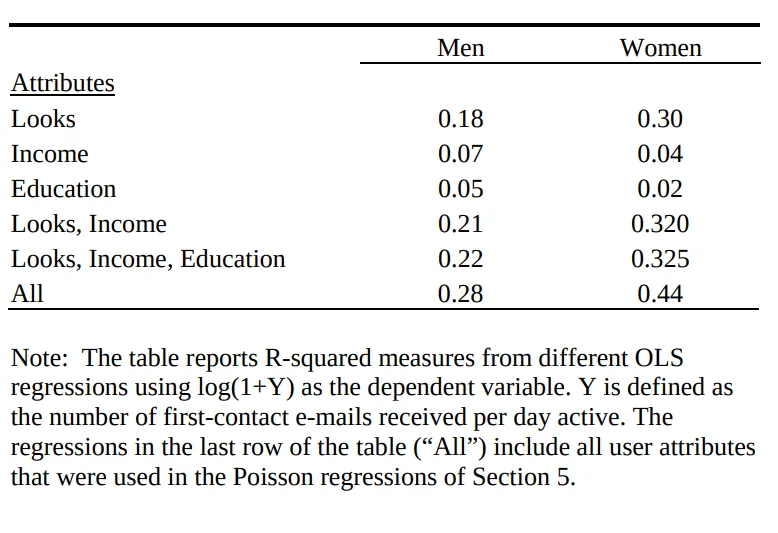
Table 5.2 from Hitsch et al. (2006): looks explains more than 2.5× the variance that income does in first-contact outcomes.
What makes this finding hard to argue with is the design. The attractiveness ratings were made on real profile photos, not controlled headshots, so they captured everything visible: lighting, grooming, clothing, setting, and body language. This is not a study about bone structure. It is a study about how men present themselves to the world, and how women respond.
The income gradient is real and visible in the data, but it is substantially shallower than the looks gradient. This is not a minor footnote. It directly challenges the widespread belief that financial success is the primary driver of male desirability on dating apps. In the Hitsch data, looks outperform income in predicting first-contact probability by a wide margin, and the gap between the two is large enough that it should shift how men spend their time and attention.
The effects extend beyond who gets noticed first. The attractiveness of the sender also drives reply rates. More attractive people who send messages receive significantly higher reply rates, for both men and women. Attractiveness compounds: it determines who gets noticed and who gets written back.
The Status Question: Real, but Widely Misunderstood
The research on status and female mate preference is more consistent than the popular debate suggests, but the mechanism works differently from what most men assume. Across surveys of tens of thousands of women spanning different cultures, ethnicities, age groups, and time periods, one preference appears reliably: perceived social status (Manson, 2012). Women are attracted to men who are more successful, more commanding, and more socially confident than they are. The intensity of this preference varies, but its presence seems to be universal.
“Studies show that women are equally attracted to men they believe have the potential to be extremely successful as they are to men who are already successful. That’s why the starving artist has no trouble finding girlfriends, and the college athlete can date models even though he can’t afford a hamburger.”
Mark Manson — Models
The key is in how status gets perceived. Material wealth — expensive watches, luxury cars, designer clothing — does register as a status signal in some contexts. But this effect is highly culture-dependent. In Western, educated, urban environments (the demographic most likely reading this), overt displays of wealth tend to read as insecure and try-hard. The man talking about his Rolex at a bar in New York or London is not raising his perceived status. He is lowering it.
What women in these contexts respond to is behavioural status: how you carry yourself, how others in a room respond to you, the degree to which your appearance signals that you take yourself seriously. Status here is not about what you own. It is about what your behaviour and appearance communicate about where you sit in a social hierarchy.

Behavioural status is visible in how a man moves through the world, not in what he owns.
This distinction matters a great deal for what men should actually do. Income is hard to change in a month. How you dress, how you groom yourself, and what your photos signal about how you value yourself are things that can change quickly. The research suggests these changes have real, measurable effects on perceived attractiveness.
The Variables You Actually Control
If photo attractiveness is the dominant driver of engagement, and if looks ratings are shaped by self-investment as much as genetics, the question becomes: what can be changed?
The answer, consistently across the literature, is: more than most men assume. Grooming, wardrobe, fit, and styling choices are not superficial. They are powerful signals of how much a man values himself, and they get read as such.
“The difference between being perceived as stylish and unstylish is night and day. A makeover and wardrobe change can make meeting and dating women three times easier literally overnight. Your outward appearance is a reflection of your self-investment — or lack thereof.”
Mark Manson — Models
Manson’s threefold claim is a qualitative observation, not a controlled experiment. But the directional logic holds up against the Hitsch data. The difference between the 40th and 70th percentile in looks ratings corresponds to roughly a 2–3× difference in incoming messages. Any intervention that moves your photos even one or two deciles up the distribution has a compounding payoff. The curve is steep precisely where most improvements land.
The controllable factors fall into two levels:
- Baseline hygiene: regular haircuts, clean skin, clothing that fits your body, dental care. These are table stakes. Men who skip them are not losing a marginal advantage — they are disqualifying themselves from the top half of the distribution.
- Presentation optimization: wardrobe choices matched to your body type, styling that reads as intentional, photos taken in contexts that imply social activity, competence, or curiosity. These move you from “acceptable” to “genuinely attractive.”
The research does not say you need to be born good-looking. It says you need to look like someone who invests in himself. That is a tractable problem.
How the Market Actually Clears: Assortative Mating
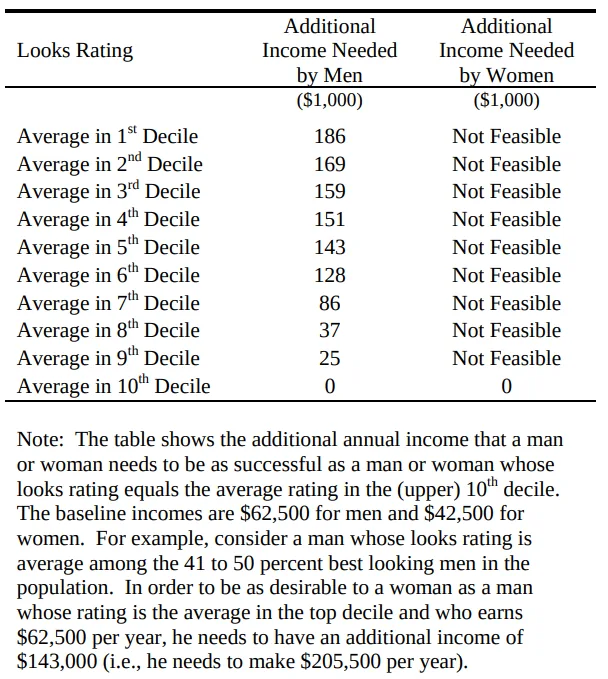
Table 5.4 from Hitsch et al. (2006): men in the bottom looks decile would need $186k extra income per year to match the appeal of top-decile men.
The data on attractiveness gradients describes who gets contacted. A separate body of research describes who actually ends up together, and the picture is equally clear.
Multiple studies reviewed in Ridley (1993) reach the same conclusion: physically attractive women and high-status, high-income men end up together at disproportionately high rates. The most striking finding is that a woman’s physical attractiveness is a better predictor of the occupational status of the man she marries than her own socioeconomic background, her intelligence, or her education.
This surprises people because it cuts against both the “looks don’t matter, be yourself” narrative and the purely materialist view that women simply trade up for resources. What the assortative mating data actually shows is that looks and status function as complementary mate value currencies: physical attractiveness is the primary currency on the female side; demonstrated status and resource acquisition is the primary currency on the male side. They trade against each other in a relatively predictable market.
The implication for men is direct. Physical attractiveness — or more precisely, its perception — is a more powerful lever than most men in Western culture are raised to believe. We are taught that looks are shallow, that women are “not like that,” that personality is what counts in the long run. The population-level data does not support this narrative. Appearance functions as a currency, and currencies can be managed.
What the Evidence Actually Says
Drawing the three threads together:
1. Photo attractiveness is the dominant driver of dating app engagement. The gradient is steep and non-linear at the top, and it substantially outperforms income as a predictor. If you are not in the top 20% of looks as presented in your photos, you are receiving a fraction of the engagement you could be getting with better presentation.
2. What “looks” means in a photo is not purely genetic. The attractiveness ratings in the Hitsch study were made on actual profile photos, not standardised face shots under controlled conditions. They captured everything visible: lighting, grooming, clothing, context, body language, and composition. A well-lit photo of a well-dressed man in an interesting location will consistently rate higher than the same face captured in a gym mirror selfie at 11pm. This follows directly from how the ratings were constructed.
3. Status signals matter, but the mechanism is behavioural rather than material. In Western contexts, the most credible status signal is self-investment: a man who looks like he has standards for himself. Expensive possessions are a weaker signal and often a counterproductive one. Appearance and behaviour that imply social confidence and self-respect are what actually register.
4. The upside is real and achievable. If grooming and styling can plausibly move a man 10–15 percentile points up the attractiveness distribution, and the curve is steep enough that 10 points corresponds to roughly a doubling of incoming messages, then the return on optimising your profile presentation is among the highest available to you. Most men are dramatically underselling themselves — not because they lack raw material, but because they have never approached the problem analytically.
What This Means in Practice
The uncomfortable conclusion the research converges on is that most men on dating apps are not losing because they are genuinely unattractive. They are losing because they have never audited what their photos actually communicate, have no systematic way to improve their presentation, and are competing against men who — through luck, coaching, or deliberate effort — have figured some of this out.
The gap between what a man looks like in real life and what he looks like on a three-inch screen is often enormous. Dating apps compress and select ruthlessly on that representation. Understanding what your photos are actually saying, and having a way to improve it, is not vanity. It is the rational response to a market where the data is clear about what drives outcomes.
The science is not going to change. The competitive environment on dating apps is not going to become less demanding. But the tools available to address these realities are better than they have ever been. Men who treat their profile presentation as a solvable problem, grounded in what the research actually says, are not cheating. They are competing.
References
- Hitsch, G. J., Hortaçsu, A., & Ariely, D. (2006). What Makes You Click? Mate Preferences and Matching Outcomes in Online Dating. University of Chicago / MIT. Working paper. Available at: home.uchicago.edu/~hortacsu/onlinedating.pdf
- Manson, M. (2012). Models: Attract Women Through Honesty. CreateSpace Independent Publishing Platform.
- Ridley, M. (1993). The Red Queen: Sex and the Evolution of Human Nature. Harper Perennial.
See what your photos are actually saying
Your profile is either working for you or against you.
Flairt analyses your photos and profile against the same research covered in this article — then builds a personalised strategy to close the gap. Built on 30+ peer-reviewed studies and real platform data.
Frequently asked questions
Do looks or money matter more on dating apps?
In the Hitsch, Hortacsu and Ariely (2006) data, photo attractiveness predicts first contact far more strongly than income, explaining more than 2.5 times the variance income does. Money helps, but the looks gradient is steeper.
Can an average-looking man improve his dating app results?
Yes. The attractiveness ratings in the research were made on real profile photos, so grooming, wardrobe, lighting and setting all counted. Moving up one or two deciles in presentation roughly doubles the messages a man receives.
Does showing off wealth make a man more attractive?
It depends on context. In urban Western settings, overt wealth signals such as luxury watches often read as try-hard and lower perceived status. How a man carries himself and invests in his appearance signals more than what he owns.