

Does Height Actually Matter? Online Dating vs. Real Life — The Full Breakdown
Every man who has ever filled out a dating profile has paused at the height field. It sits there, innocently numeric, while an entire subculture of dating-app discourse whispers that if you are under six feet you are already losing. The internet has turned “6′ minimum” into a meme, a grievance, and an article of faith all at once.
The actual data is more interesting, and considerably more useful. Height does matter in online dating. But the way it matters, when it matters, and how much it matters relative to everything else — that is where the internet narrative falls apart. And unlike your height, most of those other variables are things you can actually do something about.
The Inflation Game Nobody Wins
The average man on a dating app is roughly 1.3 inches taller on his profile than in real life.
Before even getting to what height does to your match rate, there is something worth understanding about the numbers you are competing against. Hitsch, Hortaçsu & Ariely (2006) — the most comprehensive economic study of online dating behavior to date, analysing over 22,000 US dating profiles — documented a consistent pattern: men on dating sites report heights that sit roughly 1.3 inches above national averages, across every age group studied. Women over-report slightly too, but the gap is more pronounced among men.
What this means in practice is that the height distribution you see on any major dating app is systematically inflated. When a man lists 5′11″, there is a meaningful probability he is 5′9.5″ in real life. When 80% of the men around him have done the same arithmetic, the relative competitive position barely changes — but the lie is now baked into expectations. The man who is actually 5′11″ is one of the few who is not lying.
More importantly: a height you inflated is a height she will eventually discover. First dates start with a full-body read. A man who arrives notably shorter than his listed height has, in the first five seconds, confirmed that he is willing to misrepresent himself to get in the door. That is not a great opening. Inflating your height to optimize volume at the top of the funnel typically degrades the quality and conversion of the matches you produce.
What She Actually Sees Before She Reads Your Height
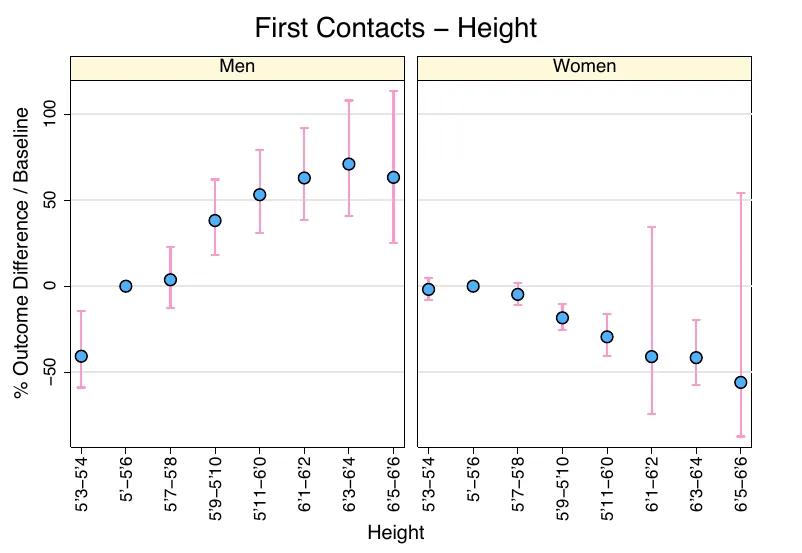
The height effect on first-contact rates is real. The same Hitsch study shows that men in the 6′1″–6′4″ range receive roughly 65% more first-contact messages than men in the 5′7″–5′8″ range. That is a significant gap — roughly the difference between average and tall.
Now compare that to what photo attractiveness produces. The same dataset, rated by 100 independent University of Chicago students for photo quality, found that men in the top 4% of photo attractiveness ratings receive over 300% more first-contact messages than men at the median. The photo variable, among every predictor tested — height, income, education, age — carries the strongest weight of all.
The mechanics explain why. On any swipe-based platform, a user sees the photo first. They make a decision in under a second based on that photo. If they do not swipe right, they never reach the height field at all. Photo attractiveness is the gate. Height is a filter that sits downstream of it. A man with a top-tier photo who is 5′8″ gets further than a man with a mediocre photo who is 6′1″. The numbers support this, not as a motivational anecdote, but as a measurable effect in revealed-preference data.
The Hard Economics of Being Short
For the men who want to understand the actual cost of being short in economic terms, Hitsch et al. calculated something illuminating: how much extra annual income would a shorter man need to be as desirable as a median-height man earning $62,500 a year?
A man at 5′0″ would need an additional $317,000 in annual income to close that gap. At 5′8″ the deficit is $138,000. At 5′10″ it falls to just $24,000 — meaningful but not unbridgeable. At 6′0″ the sign flips: the tall man can earn slightly less than the median and remain equally appealing.
These numbers are real, and they are sobering. But notice what they are measuring: the income axis specifically. The same paper places photo attractiveness as the strongest independent predictor of first-contact behavior, with a coefficient substantially larger than the height variable. Improving your photos is not an income-level investment. It is a time-and-attention investment that, for most men, will move the needle faster than a $138,000 raise.
Can She Already Guess Your Height From the Photos?
This is the question shorter men often hope has a comforting answer. The honest answer is: partially.
Women’s perception of male height from photographs is reasonably accurate when contextual cues are available. Doorframes, furniture, other people in the photo, and relative body proportions all provide information. A man photographed next to a standard door, or standing among friends where relative heights are visible, has given away a significant part of the story. Limb-to-torso ratios, shoulder width relative to standing height, and the general impression of frame all factor into estimation — often below the level of conscious analysis.
This means not listing your height does not make it invisible. But there is an important distinction between estimating height from a photo and filtering by it as a hard number. A woman who looks at a photo and thinks “he looks like he might be around 5′8″” processes that information differently from a woman who types “minimum height: 5′10″” into a filter and triggers an automatic exclusion before ever seeing the photo. The former is a soft impression formed in the context of attraction; the latter is a cold Boolean before engagement has begun.
Should You Actually List Your Height?

By the time she’s across from you at the coffee shop, a great first conversation has already changed the frame.
The strategic case for not listing your height is more interesting than most dating advice acknowledges. Here is the logic.
When a woman filters by height before seeing your photo, she is making a cold, pre-engagement decision with no context, no personality signal, no photo quality — just a number. In that moment, your height is evaluated in a vacuum and held to whatever standard her app filter is set to. If you are 5′7″ and her filter reads 5′10″, the interaction never starts.
Now consider the alternative: your height is not listed, but your photos are strong and your bio is compelling. She swiped because she liked what she saw. You match. You have a few days of good conversation. There is genuine interest on both sides. Then you meet — and she discovers you are 5′7″.
The emotional arithmetic has completely changed. She is not evaluating “5′7″ man, yes or no?” She is evaluating “this guy I already like, who happens to be 5′7″.” The height is now a single data point inside a richer picture. For a woman who was not rigidly committed to a tall partner, the answer is often “okay, a bit shorter than I imagined, but whatever.” For a woman who would not date below 5′10″ regardless of everything else, you would have been filtered at the cold stage anyway.
The honest caveat: this strategy only works if your photos and online game are genuinely strong enough to create real attraction before the meeting. If they are not, the height reveal just becomes a second disappointment on top of the first. It is not a shortcut around building a compelling profile — it is a reason why building one matters more.
The Hard Truth: What Short Men Actually Need to Do
“The single exception is height: tall men are universally considered more attractive by women than short men. In the world of dating agencies, the principle that a man must be taller than his date is so universal that it has been called ‘the cardinal principle of date selection.’”
Matt Ridley — The Red Queen (1993)
The research does not sugarcoat this. Height carries a real, consistent, cross-cultural preference signal. Matt Ridley’s summary in The Red Queen is blunt: among all physical attributes, height is the one universal. Even women who claimed that height didn’t matter to them, in experimental settings, wrote more negative personality inferences about men depicted as shorter than their partners. The preference operates partly below the level of conscious reasoning.
But Ridley’s observation should be read alongside what Mark Manson documents in his analysis of attraction surveys spanning tens of thousands of women: the most universally cited driver of male attractiveness is not height — it is perceived social status. The tall, awkward man with no presence will reliably lose to the shorter man who commands a room. Height correlates with perceived dominance and status, but it is not the only path to it, and it is not the strongest one.

Presence reads in a room before height does.
What this means for shorter men is a set of concrete priorities, not a consolation prize.
Body. Physical fitness carries more visible impact on a shorter frame. A well-built 5′7″ man with a clear V-taper and developed shoulders reads as formidable in a way that a soft 6′0″ man does not. The gym delivers proportionally larger visual returns for shorter men because muscle fills a smaller frame more visibly. This is not a myth — it is geometry. A shorter man who is visibly in shape has done something meaningful to his perceived physical dominance and health signals.
Clothes. Fit matters more at 5′7″ than at 6′1″. Poorly fitting clothes on a shorter man create a visual impression of being swallowed by fabric, which reads as low self-investment. Well-fitted clothes on the same man create clean proportions that emphasize frame without drawing attention to height. This is not complex — it requires one visit to a decent tailor or a deliberate shopping trip with fitted cuts in mind. The return on this investment is real and immediate.
Profile photos. Composition choices matter. A photo that emphasizes relative height to objects and other people is doing the worst possible thing to a shorter man’s profile. A tightly cropped photo from the waist up, taken from a slight low angle, in a context that implies social activity, does the opposite. A shorter man’s profile photo strategy needs to be deliberate: well-lit, interesting settings, relaxed expression, and no accidental height giveaways in a background of much taller friends.
Online game. Before the first meeting, a shorter man has a window to build genuine interest through wit, curiosity, and personality. This is not manipulation — it is just using the available channel effectively. By the time she is sitting across from you, a strong conversation has already established that you are an interesting person. Her experience of your height is filtered through that context, not through a cold first impression.
What About Tall Men — Is There a Ceiling?
The data consistently shows that taller is better through most of the range — up to a point. In the Hitsch dataset, men in the 6′1″–6′4″ range receive the most first-contact messages. The curve flattens noticeably past that. Men at 6′5″ and above do not show a further advantage over the 6′2″–6′3″ group.
Anecdotally, some women report finding very tall men physically inconvenient or somewhat intimidating at close range. At 6′6″ or above, there are also practical considerations: physical compatibility in everyday life, the optics of the height difference in photographs, and a subset of women who find extreme height differences uncomfortable. These are soft friction points, not hard disqualifiers. The evidence does not support the idea that men at 6′5″+ are worse off in dating — only that the height premium stops growing.
The practical takeaway is that there is an approximate sweet spot between 6′0″ and 6′4″ where the height variable contributes the most to dating app outcomes, and outside that range — whether short or very tall — other variables take over as the primary levers. For short men, those levers are the ones described above. For very tall men, the levers are the same ones as always: photo quality, social proof, presentation.
The Bottom Line
Height matters. Taller men receive more first contacts, the data is clear, and anyone who tells you otherwise is either wrong or being kind. A 5′5″ man faces a steeper climb in online dating than a 5′11″ man, and the climb gets materially harder below 5′7″.
But “steeper climb” is not the same as “wall.” The height effect, even at its maximum across a six-inch difference, is a fraction of what photo presentation produces. A shorter man with excellent photos is better positioned than a taller man with mediocre ones. The data says this directly, not as a feel-good reframe, but as a measured effect in revealed-preference behavior.
Short men who want to be competitive in online dating need to be honest with themselves: they are running with a handicap that cannot be removed. The response to that is not to obsess over the handicap — it is to be better than the competition in every dimension that can actually be improved. Body, presentation, photos, conversation. These are tractable problems, and the return on solving them is large. Report your actual height (or omit it and play the long game with strong photos). Invest seriously in how your photos present you. Do not leave winnable points on the table.
References
- Hitsch, G. J., Hortaçsu, A., & Ariely, D. (2006). What Makes You Click? Mate Preferences and Matching Outcomes in Online Dating. University of Chicago / MIT. Working paper. Available at: home.uchicago.edu/~hortacsu/onlinedating.pdf
- Ridley, M. (1993). The Red Queen: Sex and the Evolution of Human Nature. Harper Perennial.
- Manson, M. (2012). Models: Attract Women Through Honesty. CreateSpace Independent Publishing Platform.
- Stulp, G., Buunk, A. P., & Pollet, T. V. (2013). Women want taller men more than men want shorter women. Personality and Individual Differences, 54(8), 877–883.
- Stulp, G., Buunk, A. P., Pollet, T. V., Verhulst, S., & Fidler, A. (2013). Are human mating preferences with respect to height reflected in actual pairings? PLOS ONE, 8(1), e54186.
Your photos are doing the heavy lifting
Height is one variable. Your photos control the biggest one.
Flairt analyses what your profile photos are actually communicating — photo quality, composition, setting, grooming, self-presentation — then builds a personalised strategy to move you up the distribution where it matters most. Built on the same research covered in this article.
Frequently asked questions
Does height really matter in online dating?
Height affects first contact, but less than most men assume. The effect is real and measurable, yet it sits below photo quality and overall presentation as a driver of matches.
How much taller do women say they want a man to be?
Stated preferences run higher than real behaviour. Women report wanting a large height gap, but the messaging data shows the penalty for being shorter is smaller than the surveys suggest.
Can shorter men do well on dating apps?
Yes. Shorter men who present well in their photos and lead with confidence close most of the gap. Height is fixed; presentation, grooming and framing are not.