

What Actually Makes a Face Attractive? The Science Nobody Told You
Most men approach their face with one of two attitudes: either they assume they're good enough and don't think about it, or they've decided they lost the genetic lottery and moved on. Neither position is wrong exactly. They're just incomplete. Because the science of facial attractiveness describes something considerably more interesting than a binary outcome — and considerably more actionable.
There are three biological drivers of facial attractiveness that researchers have documented across dozens of experiments and multiple cultures. You probably can't change any of them directly. But understanding what they signal, and how they interact with things you actually can control, is where most men are leaving a lot on the table.
It Is Not as Subjective as You Think
"Beauty is in the eye of the beholder" is a comforting idea that the data does not support. A comprehensive meta-analysis by Gillian Rhodes (2005), covering dozens of studies across different populations and methodologies, found that people from different cultures largely agree on which faces are attractive — and this agreement crosses sex lines too. Men and women largely converge on which male faces are appealing, and which aren't.
What makes this finding hard to argue with is how early these preferences show up. They emerge in infants, before cultural standards of beauty have had time to take root. That suggests something biological is at work, not just fashion or media conditioning.
And the stakes are real. Attractiveness ratings correlate 0.97 with ratings of desirability to date and 0.93 with desirability to marry (Cunningham et al. 1990, cited in Rhodes 2005). These aren't arbitrary aesthetic preferences scattered randomly across the population. They are consistent signals that map tightly onto mate choice. The feedback you get — or don't get — on a dating app is not random noise. The pattern is real, and the factors driving it are knowable.
Symmetry: The Health Readout You Cannot Fake

Grooming and lighting change how symmetry is read — even on a structurally similar face.
Bilateral symmetry — how closely the left and right sides of your face mirror each other — is one of the three core signals of facial attractiveness. The reason traces back to developmental biology. Small asymmetries build up during growth in response to stress: poor nutrition, illness, genetic instability, environmental disruption. A more symmetric face is evidence that your body handled its development without significant problems. It functions as a proxy for genetic quality and overall health.
The meta-analysis effect size for symmetry is 0.25 — a medium effect, consistent across many studies. Symmetric faces are reliably perceived as more attractive, healthier, and more desirable as long-term partners, even when raters are not consciously aware they're picking up on it.
What is worth noting is that symmetry is not purely about your bone structure. Grooming plays a real role. Uneven stubble, slightly mismatched eyebrows, one eye appearing more open than the other in photos — these all add perceived asymmetry to a face that might be structurally quite symmetric. A well-groomed, evenly lit face reads as more symmetric than the same face captured carelessly. The camera magnifies these differences in ways the naked eye in person sometimes does not.
Averageness: The Paradox That Actually Makes Sense
This one trips people up. When researchers computationally blend many faces into a single composite, the resulting face consistently rates as more attractive than most of the individuals that went into it. The more faces added to the composite, the more attractive it becomes — up to about 16 faces in the blend.
This sounds strange until you understand what "average" actually signals biologically. An average face represents a broad genetic mix — many different alleles blended together. That diversity correlates with a more robust immune system, better disease resistance, and greater developmental stability. The face that looks "average" is, in evolutionary terms, advertising something genuinely valuable. It's not ordinary — it's evidence of healthy genetic diversity.
The effect size for averageness is 0.52 in the meta-analysis — a large effect, and the strongest of the three structural variables. It holds across race, sex, and culture. A face closer to the population average for its sex tends to be rated more attractive, not despite being unremarkable in a distinctive way, but because of what unremarkable represents genetically.
The counterintuitive practical implication: trying to look maximally distinctive or unusual in your photos often works against you. An approachable, regular-looking face presented in good condition tends to outperform a highly unusual face that generates mixed reactions. The goal is to look like the best version of a familiar type, not to look like nobody else.
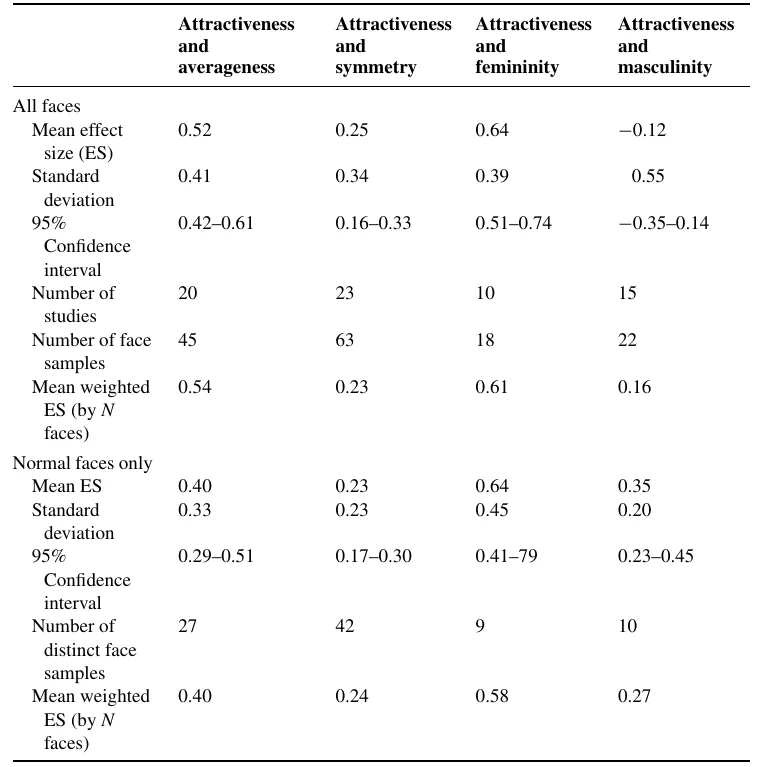
Table 1 from Rhodes (2005): meta-analysis across 20–63 studies. Averageness and femininity show large effects; symmetry a medium effect; and masculinity is slightly negative overall — which is the finding that most surprises people.
Masculinity: The Variable That Shifts With Context
Here is where the science gets genuinely interesting, and where most internet debate about alpha faces and jawlines gets it wrong. The meta-analytic effect of masculinity on male facial attractiveness is slightly negative overall — an effect size of −0.12 across all faces tested. When researchers ask women to rate male faces, they generally prefer slightly more feminized versions of those faces, not the most masculine versions.
But that is the average across all conditions. The picture changes dramatically when you look more closely. Little et al. (2002) found that women's preferences for masculinity in male faces shift significantly based on context. Women who were already in relationships showed stronger preferences for masculine faces. Women considering short-term rather than long-term partners also preferred more masculine faces. The effect disappeared entirely in women using oral contraception.
“Preferences for masculinity are increased when women either have a partner or are considering a short-term relationship. Individuals using oral contraception do not show the above effects, indicating that such hormonal intervention potentially disrupts women’s choices for evolutionarily relevant benefits from males.”
Little et al. (2002) — Proceedings of the Royal Society B
The logic behind this pattern is evolutionary. Masculine facial features — strong jawline, prominent brow ridge, angular structure — develop in response to testosterone during growth. High testosterone is immunosuppressive, which means only genuinely healthy men can develop strong masculine features while maintaining a functional immune system. A highly masculine face is, in that sense, an honest signal of immune robustness and genetic quality. These are traits worth passing to offspring.
The complication is that masculine men also tend to score lower on warmth, cooperativeness, and willingness to invest in parenting. For a woman assessing a long-term partner who will be present day to day, those tradeoffs matter. For a short-term encounter, they matter much less. The female preference system appears to be calibrated to this tradeoff in a way that is rational and adaptive — which is why the same face reads differently depending on the context in which it's being evaluated.
The practical takeaway: a composed, slightly serious expression in photos communicates many of the same signals as facial masculinity, without requiring any particular bone structure. Expression and demeanor carry part of the job that testosterone does structurally.
Your Expression Changes What Your Face Is Saying

Warmth and confidence together — not one or the other — is what reads as most attractive in a photo.
Among the components of facial attractiveness, Rhodes (2005) lists a pleasant expression in the same category as symmetry and averageness. This detail gets overlooked in discussions that focus entirely on structural features, but it is arguably the most actionable variable of all — because it changes completely from photo to photo.
The face is an emotional readout. In a photo, that readout is frozen. A photo where you look tense, guarded, or vaguely bored communicates something specific about your emotional state — and about how it probably feels to be around you. A photo where you're caught mid-laugh, or smiling at something just off-frame, communicates something entirely different. These aren't subtle differences. They register immediately.
This matters especially for men because of how masculinity interacts with expression. A man with stronger features who also smiles genuinely rates as both attractive and approachable — the combination is potent. The same man with a forced or neutral expression reads as cold, difficult to read, or trying too hard to look serious. Most men default to a stern face in photos because it feels more confident. The research suggests the opposite is often more effective.
And then there are the eyes. They are the primary feature women focus on when assessing male faces — not the jaw, not the overall structure, the eyes. A photo where you look directly into the camera with a relaxed, genuine expression is doing more work than almost any other single composition choice you can make. That combination — direct eye contact, warmth visible in the expression — signals presence, confidence, and approachability simultaneously.
What You Can Actually Do With This
You cannot restructure your face. But the science points clearly to variables that are both real and controllable.
Grooming affects perceived symmetry. Even stubble, consistent brows, clean skin, and a haircut that is maintained rather than grown out — these reduce perceived asymmetry on a structurally ordinary face. The camera picks up unevenness that you stop noticing in the mirror. A groomed face reads as more symmetric and healthier, even when the underlying structure hasn't changed.
Expression simultaneously signals warmth and status. A relaxed genuine smile communicates approachability. A slight, composed expression with direct eye contact signals dominance and presence. Both are attractive in different contexts. Understanding which your current photos are projecting — and whether it's intentional — is the first step to fixing it.
Lighting changes how symmetry and structure are read. Harsh overhead light creates shadows that emphasize every asymmetry in a face. Soft, even light from a slight angle fills those shadows and makes faces look cleaner and more balanced. This is not a technicality for photographers — it is directly connected to how attractiveness signals are processed.
Angle affects perceived facial structure. Slightly lower angles emphasize jaw and brow structure. Slightly higher angles soften features. Most men have never deliberately thought about what angle their photos are taken from, even though the effect on perceived facial masculinity is real and consistent across studies.
And perhaps most importantly: women respond to cues they often cannot articulate. The research consistently shows a gap between stated preferences and revealed preferences. Women who report that looks don't matter still respond primarily to the face in photos. Women who report not caring about masculinity show the measurable preference shifts described above. Your job is not to optimize for what she says she wants — it is to understand what the evidence shows she responds to, and present yourself in a way that is aligned with that reality.
The Part Nobody Teaches Men
Women have spent their entire lives learning how to present their face. What lighting is flattering. Which angles work. When to smile and when to hold a look. Which expression communicates warmth without looking needy. They didn't read academic papers to figure this out — it was absorbed through social feedback, culture, and years of practice.
Men get almost none of that. Most guys figure out their dating photos the same way they figured out their teenage haircut: trial and error, with no real feedback and no framework. The result is that the average man's profile photos are doing a fraction of the work they could be doing — not because his face is a problem, but because nobody ever showed him how to read the variables, let alone how to optimize for them.
The face — and specifically the eyes — remains the number one feature women respond to when viewing a profile. Even women who claim otherwise respond primarily to the face. Understanding what your face is actually communicating in your current photos — the expression, the lighting, the grooming consistency, the angle — is the starting point. Everything else follows from there.
References
- Rhodes, G. (2005). The Evolutionary Psychology of Facial Beauty. Annual Review of Psychology, 57, 199–226. doi:10.1146/annurev.psych.57.102904.190208
- Little, A. C., Jones, B. C., Penton-Voak, I. S., Burt, D. M., & Perrett, D. I. (2002). Partnership status and the temporal context of relationships influence human female preferences for sexual dimorphism in male face shape. Proceedings of the Royal Society of London B, 269, 1095–1100. doi:10.1098/rspb.2002.1984
- Cunningham, M. R., Roberts, A. R., Barbee, A. P., Druen, P. B., & Wu, C. (1990). “Their ideas of beauty are, on the whole, the same as ours”: Consistency and variability in the cross-cultural perception of female physical attractiveness. Journal of Personality and Social Psychology, 68, 261–279.
- Langlois, J. H., Kalakanis, L., Rubenstein, A. J., Larson, A., Hallam, M., & Smoot, M. (2000). Maxims or myths of beauty? A meta-analytic and theoretical review. Psychological Bulletin, 126, 390–423.
Your face, finally working for you
You can’t change your structure. You can change everything else.
Flairt analyses your current dating photos against the science covered in this article — expression, perceived symmetry, lighting, angle, grooming consistency — and builds a personalised playbook for what to improve. The face is the variable women respond to most. Make yours work harder.
Frequently asked questions
What makes a face attractive?
Research points to three measurable drivers: symmetry, averageness (how close features sit to the population mean) and sexual dimorphism such as masculine features in men. Each shifts attractiveness in predictable ways.
Is facial attractiveness fixed, or can you change it?
The underlying bone structure is fixed, but how a face reads in a photo is not. Lighting, angle, grooming, expression and framing move perceived attractiveness without changing the face itself.
Does facial symmetry actually matter for attraction?
Yes. Across studies, raters consistently prefer more symmetric faces. The effect is real but modest, and good photography can emphasise a face's stronger angles.