

You Matched. Now What? The Science of Going From a Match to an Actual Date
The match notification lands and there’s a brief rush. Then nothing. Because now you have to actually say something — and that is where most guys stumble. The inbox fills up, the conversation goes flat after two exchanges, or it just fades into the ghosting void that has become the unofficial fourth stage of online dating.
The match is not the moment. It is the starting gun. Getting from that notification to a real, face-to-face date requires a set of skills that nobody explicitly teaches men, and that most men learn, if at all, through years of expensive failure. This article tries to compress that learning curve.
The Match Does Not Mean What You Think It Means
It helps to understand what a match actually represents before you treat it like a guarantee. Research by Hitsch, Hortaçsu & Ariely (2006) on a major US online dating platform found that 71% of men’s and 56% of women’s first-contact messages receive no reply at all. This is not a bug in the system. It is the system. Women match with multiple people and respond to the ones who stand out. Getting a match means she swiped right. It does not mean she is invested.
The same data showed that reply rates were strongly tied to how attractive the sender’s photos appeared to independent raters. More attractive senders got written back at significantly higher rates. This matters because it tells you something uncomfortable: the game does not fully reset after the match. Your photos got you in the room. But what you say in those first few messages either confirms or kills her initial impression.
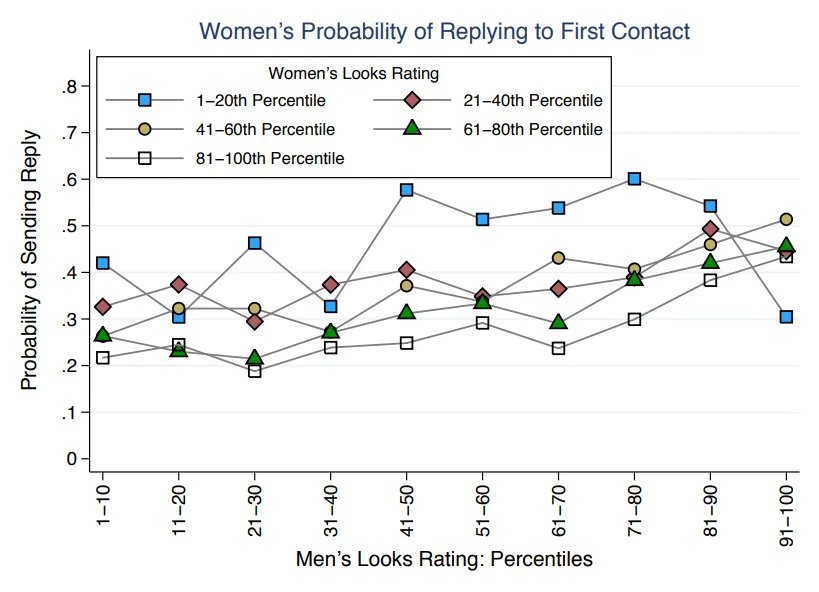
Hitsch et al. (2006): reply rates increase sharply with the sender’s photo attractiveness rating. A match is an invitation, not a commitment.
None of this is cause for fatalism. It is cause for precision. Knowing that her attention is still conditional means that the opener and the first few exchanges matter more than most men assume.
The Opener: Stop Trying to Be Nice
The default opener most men send is some variation of “hey”, “how’s your day”, or a compliment about her appearance. These feel safe because they are inoffensive. They fail because they are invisible. She has already received twelve of them today from twelve guys who all thought the same thing.
What actually works is something polarizing in the best sense of the word: a message that is specific, slightly unexpected, and signals that you actually looked at her profile rather than copy-pasting a template. The classic mechanism here is a playful comment or light tease about something in one of her photos. Not a compliment. A riff. If her photo shows her at what is clearly a very touristy landmark, you might riff on that. If she is holding a clearly losing hand of cards in one photo, you have material. The goal is to open a thread she can pull on, not close a loop with a generic exchange.
“It is not a time to introduce yourself. It is not a time to compliment her or spend money on her. The first interesting thing about a strong opener is that he isn’t seeking rapport with the girls or trying to impress them. He’s not being needy, or rude, or overly nice.”
Mystery — The Venusian Arts Handbook
A useful rule of thumb: your opener should be something that she cannot plausibly receive from a hundred other guys on the same day. Specificity is the mechanism. Generic goodwill is the enemy. An opener that lands is one she wants to show her friend.
There is also an energy component to this. Mystery’s observation that you should come in “at an energy level slightly higher than that of the set” translates to text fairly directly: a message with a bit of enthusiasm, a light sense of humour, and no desperation in its DNA reads as high-status. A message that is overly careful, hedging, or flattering reads as low.
The Two Things Every Conversation Needs
Once the conversation gets going, most men default to one of two failure modes. They either become hyper-logical — exchanging facts and interests as if filling out a form — or they try to be funny at the expense of anything substantial, and she ends up entertained but not interested. The research on what drives sustained attraction in conversation points to something more specific.
A productive interaction needs two parallel threads running at the same time: attraction and comfort. Attraction is the feeling that this man is interesting, confident, and a little bit unpredictable in a good way. Comfort is the sense that he is also trustworthy, real, and not about to be weird if she meets him in person. These two things work together, not against each other. A man who generates attraction without comfort is exciting but feels unsafe. A man who builds comfort without attraction becomes a friend.
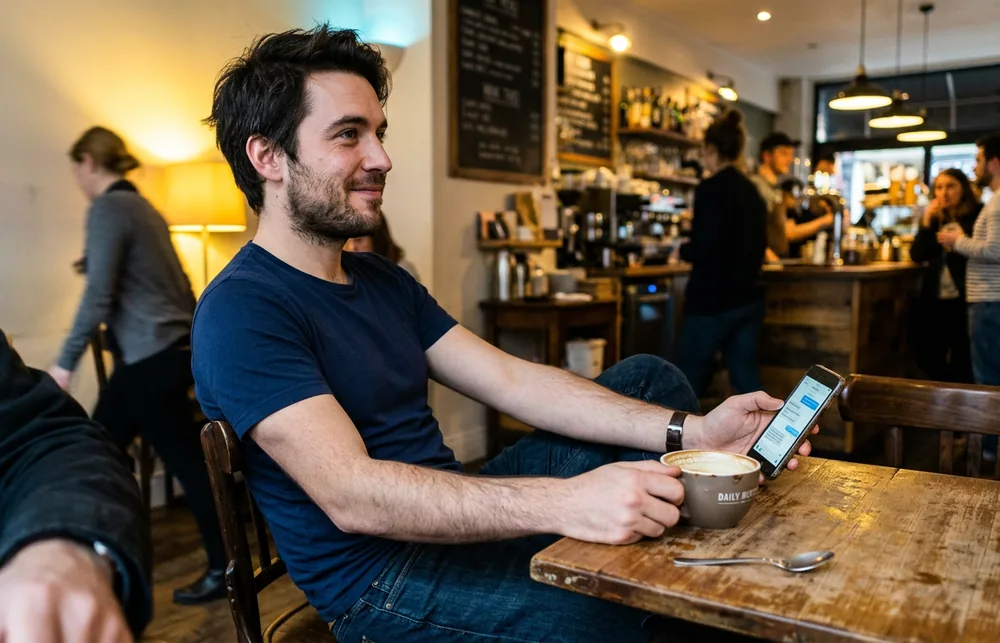
Confidence in a text conversation is not about what you say. It’s about what you don’t chase.
David DeAngelo’s observation in Double Your Dating that “if you can keep her laughing, you will go far” is not just bro-science. It maps onto what we know about dominance, confidence, and social signalling. Humour, in this context, is not about being a comedian. It is about demonstrating that you are comfortable, not trying too hard, and that you have a perspective she finds interesting. Mark Manson’s Models makes the underlying mechanism explicit: women are drawn to men who value their own self-perception more than her perception of them. A man who is trying to be funny is visibly trying. A man who is just riffing from a place of genuine ease is attractive.
Confidence, as Manson puts it, “is not consciously calculated by women. It is felt. It is intuited. It is instinctual.” The practical translation for a text conversation: you can be warm and interested without being eager. You can be funny without trying to earn a laugh. You can ask questions without interrogating. The difference between these modes is the difference between a man who feels like an opportunity and a man who feels like an interview he’s hoping to pass.
Getting Her Off the App
At some point — and ideally sooner than most men do this — you want to move the conversation off the dating app and onto another platform. The standard approach is to suggest Instagram or WhatsApp. This is a good idea for reasons that are more interesting than they first appear.
The surface reason is practical: you become a real person with a verifiable presence, not an anonymous profile she could be misreading entirely. But the deeper mechanism is compliance. When you ask someone to do something small and they do it, they have made a micro-commitment. They have invested marginally more in the interaction. This is not manipulation — it is how human social bonding works. Mystery’s framework captures this precisely: “All compliance builds upon itself. Someone complying will continue to comply.” Getting her to follow you on Instagram or save your number is a small act with a real psychological effect.
There is also a signal you send by having an active Instagram account: without having to say a single word about yourself, your profile communicates your social life, your interests, your aesthetic, your niche, and whether other people find you interesting. A well-curated Instagram is a passive attraction machine. It does the work of ten conversation exchanges in a single scroll.
Read Her, Don’t Chase Her
One of the most consistent mistakes men make in the texting stage is misreading how much investment is appropriate. The pull to match her energy, or to over-invest hoping she will catch up, creates patterns that kill attraction before the first date even gets scheduled.
The practical read is this: ideally, she should be investing roughly as much energy as you are. Responses that are close in length to yours, replies that arrive in a timely way, questions she asks that show she is actually curious about you — these are the signals you are looking for. They mean the interaction is working.
But the early stages rarely look like this. At the beginning, you will almost always be investing more. This is expected. You are the one initiating. What matters is the direction of travel. Is she warming up over several exchanges, or is she giving one-word replies on a four-hour delay?
If it is the latter, the answer is not to push harder. It is to take your foot off the gas. A single well-timed message after a few days of silence does more for your attractiveness than five escalating follow-ups. Never call out her delays. Never pressure. Never put her in a position where she has to justify her responsiveness to you. If the interaction fizzles despite your best effort, let it go. The quality of your other options is the only thing that makes this easy — which is its own argument for being active on multiple fronts rather than tunnel-visioning on one match.
The Date Ask: Lead, Don’t Deliberate
When the conversation is going well — she is asking questions, she is replying quickly, she seems genuinely engaged — most men make the mistake of extending the texting phase indefinitely. It feels good to have a conversation that is working, and there is a fear that suggesting a date will break the spell. This logic is backwards.
Research by Baxter et al. (2022) on modality switching in online dating found that participants who moved their interaction to an in-person meeting had significantly higher romantic interest scores at follow-up than those who remained in digital contact. The meeting itself is not just a milestone — it is a catalyst. Time spent texting is not banked towards eventual attraction. In-person time is.
The practical implication: if the conversation is good and she seems engaged, ask. Do not hint at it, do not suggest that maybe at some point you might possibly hang out, do not ask what she is generally doing this week. Take leadership. Propose a specific thing. Something like “I’m enjoying this conversation — let’s get a drink on Thursday” is direct without being aggressive. It communicates that you are interested enough to take initiative and confident enough not to hedge it into oblivion.

In-person time is not just the goal — it is where genuine attraction actually forms.
Keep the proposition simple and low-stakes. Coffee works. A casual bar works. Dinner for a first date puts too much pressure on both sides and the data on first-date success suggests that shorter, more spontaneous meetings tend to outperform long formal ones for establishing romantic interest (Baxter et al., 2022). The point is to get in the same room. The conversation, the body language, the actual experience of being with you — those are the things that close the deal, not a perfectly crafted text exchange.
The Photo Got You the Match. Now What?
Here is the through-line that connects all of this back to the beginning: the quality of your photos determines who you match with, but the quality of your conversation determines whether those matches go anywhere. And how well the conversation goes is shaped partly by how much she was drawn to your profile in the first place.
Men who are on the margins of the attractiveness distribution on dating apps — not bad looking, but not clearly in the top tier either — tend to get matches with women who are somewhat lukewarm. A lukewarm match is much harder to convert. She is more likely to ghost, more likely to give minimal replies, more likely to decide she is “not really looking for anything serious right now.” The man who matches with women who were genuinely excited to swipe right on him starts the texting phase with a significant built-in advantage.
This is not a reason to despair if your photos are currently average. It is a reason to take the photo problem seriously. The returns on improving your profile presentation compound from the first swipe all the way to the first date — because you are not just getting more matches, you are getting matches with women who are already more interested in you before you say a single word.
Flairt was built around exactly this insight. Most men are not losing the dating game because they lack social skills or confidence. They are losing because their photos do not represent who they actually are — and nobody has ever told them how to fix that, or why it matters as much as it does.
References
- Hitsch, G. J., Hortaçsu, A., & Ariely, D. (2006). What Makes You Click? Mate Preferences and Matching Outcomes in Online Dating. University of Chicago / MIT. Working paper. Available at: home.uchicago.edu/~hortacsu/onlinedating.pdf
- Mystery (Erik von Markovik). (2007). The Venusian Arts Handbook. Mystery Method Corporation. Available at: scribd.com
- DeAngelo, D. (2001). Double Your Dating: What Every Man Should Know About How to Be Successful with Women. Available at: scribd.com
- Manson, M. (2012). Models: Attract Women Through Honesty. CreateSpace Independent Publishing Platform.
- Baxter, A., et al. (2022). Initial impressions of compatibility and mate value predict later dating and romantic interest. Proceedings of the National Academy of Sciences. doi.org/10.1073/pnas.2206925119
Before the conversation even starts
The match comes from the photo. Make sure yours is working.
Flairt analyses your photos against the same research covered in this article — attraction signals, first impressions, and what actually makes women swipe right and stay interested. Built on 30+ peer-reviewed studies and real platform data.
Frequently asked questions
What should your first message to a match be?
Open with something specific to her profile rather than 'hey'. A short, personalised opener that invites a reply beats generic lines and low-effort compliments.
How quickly should you move a match off the app?
Build a little rapport first, then suggest a date within the first day or two of good conversation. Waiting too long lets the match go cold; rushing before any connection reads as pushy.
Why do matches stop replying?
Conversations stall when they turn into interview-style question swaps with no momentum. Steering toward a concrete plan keeps the exchange moving instead of fading.