

Cold Approach vs. Dating Apps: Which Actually Works Better for Building Real Connection?
Welcome to May. The terraces are filling up, the evenings are lasting longer, and the summer you have been waiting for is finally close enough to taste. If there was ever a time to get your dating life in order, it is right now — before everyone else wakes up and realizes the same thing.
So let's settle a debate that has been running since the first dating app hit the App Store. Is it better to walk up to someone in real life, or grind it out on the apps and let the algorithm do the work? Both sides have their devotees, their war stories, and their genuine points. But the question is not really which one "works." It is what each channel is actually testing, who it favors, and what that means for how you spend your time and effort.
Both Channels Run on the Same Clock
Here is what most people miss in this debate: cold approach and dating apps are not opposites. They both rely on the same fundamental mechanism, which is the first impression. The timescales are just radically different.
Researchers at Princeton found that people form confident judgments about a stranger's face within 100 milliseconds of seeing it — before any conscious deliberation can even begin (Willis & Todorov, 2006). On a dating app, those snap judgments determine whether someone gets a swipe right or a pass. In person, they happen just as fast but they also include everything else: how you move, how you hold yourself, what your energy communicates before you have said a single word.
And here is the part that makes those first impressions matter beyond just the immediate moment: they actually predict what comes next. A large study published in PNAS by Baxter et al. (2022) tracked speed-dating participants across multiple studies, measuring their initial romantic interest right after a first meeting. That early read, formed in minutes, was a strong predictor of whether people later initiated contact and whether a real relationship developed. First impressions are not just superficial noise. They carry genuine predictive weight about where things are headed.
Cold Approach: The High-Bandwidth Channel

Body language says everything before the conversation even starts.
When you approach someone in person, you are broadcasting across an enormous number of channels simultaneously. The dating coach David DeAngelo put it plainly: "When two people are communicating in person, most of the communication is happening through body language and voice tone, and very little through the actual words. As little as 7% of your communication is the words, and the other 93% is your body language and voice tone."
This is not a dating hack. It is just how human communication works, and it shapes everything about what cold approach is testing. When you walk up to someone, she is reading your posture, your pace, the direction your shoulders are pointed, the steadiness of your gaze, whether your voice has weight behind it or trails off. She is not consciously analyzing these things. She is feeling them. DeAngelo observed that women are particularly sensitive to this kind of signal, picking up on insecurity, neediness, and low social calibration faster than most men realize.
This is the core advantage of cold approach: you are a complete, three-dimensional person. Nothing is compressed. The attraction that forms — or doesn't — is based on real, high-resolution data. If you have genuine charisma, warmth, and social ease, cold approach is where those traits do their best work. None of them are legible in a static photo.
The downside is equally clear. If your fundamentals are not there — if you are not yet confident, if anxiety tightens your posture and cuts your voice short — that signal also transmits in full resolution. Cold approach rewards men who have done the internal work. It punishes those who have not.
Dating Apps: Different Rules, Same Objective
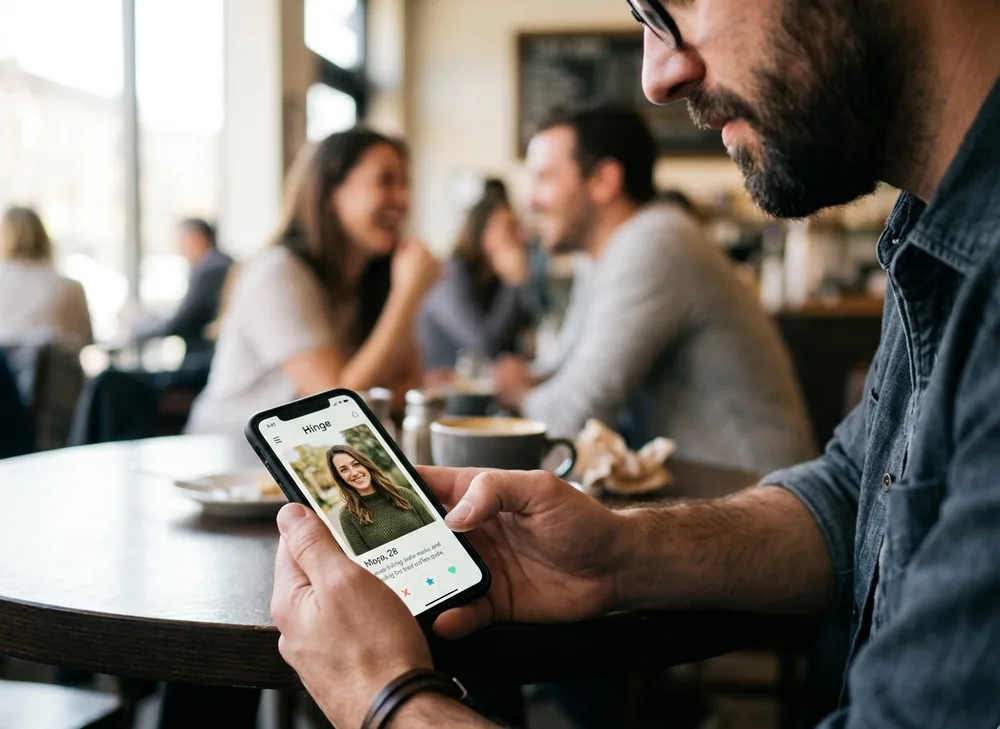
On an app, a single photo is doing the work of an entire first interaction.
Dating apps strip out body language, vocal tone, real-time social calibration, and everything else that falls under that 93%. What remains is the photo, a handful of other photos, and a bio most people will not read unless they are already intrigued. That sounds like a massive compression — and it is. But it is not nothing.
Photos still communicate a great deal. They show how you present yourself, what your social context looks like, whether your clothing and grooming suggest someone who takes himself seriously, and whether the settings you photograph yourself in imply an interesting life. A photo is not as rich as a live interaction, but it is not silent either. It is doing its job across a narrower frequency range.
The game on apps is therefore different in a specific way: because body language and voice are not available, the static signals — looks, apparent style, perceived social proof — carry proportionally more weight. The man who is electrifying in person but photographs badly will not get that chance to be electrifying. The man who photographs exceptionally well will get the date regardless of whether his in-person energy lives up to the photo.
Apps also change the pace. The attraction that forms through a match, a conversation, and a meeting develops over days rather than seconds. For some people, that slower burn is actually an advantage — it gives them time to warm up and build genuine connection before the high-stakes face-to-face moment.
Who Each Channel Actually Favors
This is where the honest answer gets useful. Neither channel is universally better. They favor different men, and understanding which category you fall into is genuinely valuable information.
If you are naturally reserved, introverted, or anxious in high-pressure social situations, dating apps tend to give you a more level playing field. You can build real conversational chemistry before the stakes get high. Your wit, thoughtfulness, and genuine interest in another person come through in a medium that rewards those qualities. Cold approach, where everything is compressed into an unscripted 30-second window, is a fundamentally unfair arena for someone whose strengths take time to emerge. That does not mean avoid it. It means your highest expected return is probably on the apps.
If you are naturally extroverted, socially confident, and at your best when you are in a room with people, cold approach is almost certainly where you outperform. Your body language communicates competence, your voice carries warmth, and your ability to read and respond to someone in real time is your real competitive edge. Many men in this category are quietly terrible at apps — not because they are less attractive, but because their actual presence does not translate to static images. Their profile undersells them systematically, and they often have no idea.
The Modality Problem: Where Real Value Gets Leaked
There is a fascinating and underappreciated thing that happens when online dating works: at some point, it stops being online. You have to meet. Research by Caughlin et al. (2017) on modality switching (the transition from online to in-person) found that this moment is genuinely predictive — real face-to-face interaction reveals things that photos and text conversations simply cannot.
For some men this is a positive surprise. They show up and are considerably more attractive in person than their photos suggested. The energy that could not be bottled into a jpeg is finally visible. For others it works the other way: the carefully selected photos created an expectation the real interaction did not meet. The gap between your online representation and your real presence cuts both ways, and most men are not aware of which direction theirs runs.
The implication for cold approach guys is direct: if apps are not producing results but you reliably do well when you actually talk to people, the problem is almost certainly the photos. Not you. The channel is misrepresenting you.
The Photo Is Your Cold Approach on Apps
Here is the reframe that ties this together. On a dating app, your profile photo is your cold approach moment. It is the 3-second window in which someone decides whether to invest more attention or move on. It is doing, badly, the job that your physical presence would do well — communicating who you are, what kind of social world you inhabit, and whether you are someone worth knowing.
For the reserved guy who relies on apps, this means the photo is the bottleneck. He is getting the date by building conversational rapport, but only if he clears the photo threshold first. A weak photo means the conversation never happens. His actual strengths never get to show up.
For the confident guy who excels in person, it means the same thing from a different angle. His real-world game is excellent, but his photo is the gatekeeper to a channel he is largely ignoring. Every man he is competing against on apps who has genuinely good photos is receiving matches he is not.
Both types of men have the same bottleneck. What the photo communicates — about your social calibration, your self-investment, the quality of your life as visible through carefully selected imagery — determines whether any of your other strengths even get a chance to matter.
The Practical Conclusion
Cold approach and dating apps are not competing strategies. They are different instruments for the same goal, and the smart play is understanding which one you are currently underperforming in and why.
If cold approach is not your strength yet, the apps give you a real opportunity — but only if you treat the photo side seriously. If cold approach is your strength and the apps feel like a dead end, your photos are almost certainly the reason. In both cases the analysis is the same: your photos are either representing you accurately or they are costing you matches you should be getting.
Most men have never actually audited what their photos communicate. They have not looked at their profile the way a woman swiping at midnight looks at it — quickly, without context, with nothing but the image to go on. Building a profile that works in that environment is a tractable problem. It just requires treating it as one.
This summer is going to be full of opportunities, in bars, on streets, in apps. The question is whether you show up to all of them, or only the ones where the format happens to suit you.
References
- Willis, J., & Todorov, A. (2006). First impressions: making up your mind after a 100-ms exposure to a face. Psychological Science, 17(7), 592–598.
- Baxter, A., et al. (2022). Initial impressions of compatibility and mate value predict later dating and romantic interest. Proceedings of the National Academy of Sciences, 119(39), e2206925119. Available at: pnas.org/doi/10.1073/pnas.2206925119
- DeAngelo, D. (2004). Double Your Dating. Cliff's List / self-published.
- Caughlin, J. P., et al. (2017). What predicts first date success? A longitudinal study of modality switching in online dating. Personal Relationships, 24(2), 370–391.
Find out what your photos are actually communicating
Your profile is either representing you — or misrepresenting you.
Flairt analyses your photos and profile against 30+ peer-reviewed studies on attraction and online dating behavior, then builds a personalised strategy to close the gap. Whether your strength is in-person or online, your photos are the bottleneck.
Frequently asked questions
Is cold approach better than dating apps?
They test different things. Apps filter on photos and a first impression at scale; in-person approach lets your presence, voice and body language carry the interaction. Each favours a different kind of man.
Which works better for building a real connection?
Meeting in person front-loads chemistry, since she reads your full presence at once. Apps can still lead to strong connections, but the early screening rests almost entirely on your photos.
Can you do both cold approach and apps at once?
Yes, and many men should. Apps supply volume; in-person practice builds the social skills and confidence that also make your dates go better.