

Talk to Doorknobs: Why Social Abundance Beats Every Other Dating Strategy
There is a very specific kind of guy who confuses everyone. He is not the best looking man in the room. He does not drive the nicest car. His wardrobe is fine, not great. And yet he always seems to be the one talking to the most interesting woman at the party, while the better-looking guy by the bar is staring at his phone.
Most men, if they're honest, have met this guy. Most have also wondered what he's doing that they aren't. The cope explanation is "he's just charming" — as if charm fell out of the sky onto him personally. The actual answer is much more useful, and it's something you can actively build: he is socially abundant. He talks to everyone. He acts like he owns the place even when he doesn't. He moves through groups, merges them, jokes with strangers, and treats the entire room like an extension of his living room.
He talks to doorknobs. And it shows up in everything from how women perceive him in three seconds to how his face moves when he is mid-sentence to how clearly he pronounces his words. This article is about why that single trait — broad, genuine, almost careless social presence — is the highest-leverage dating skill there is, and what the research has to say about why.
Pre-Selection Is Real, Whether You Like It or Not
Here is something that is hard to dispute and slightly uncomfortable to sit with: women find a man more attractive when other women already seem to like him. This is not a pickup-artist myth, and it is not a moral statement. It is a finding that has shown up reliably in controlled experiments for years.
Gouda-Vossos, Dixson and Brooks (2016) ran a clean test of this. They had 2,044 raters evaluate male and female stock-photo models presented in three social contexts — alone, with a same-sex other, or with an opposite-sex other. The result for male models was unambiguous: men photographed alongside a woman were rated as significantly more attractive than the same men photographed alone or with another man. Same face. Same outfit. Different social context. Higher score.
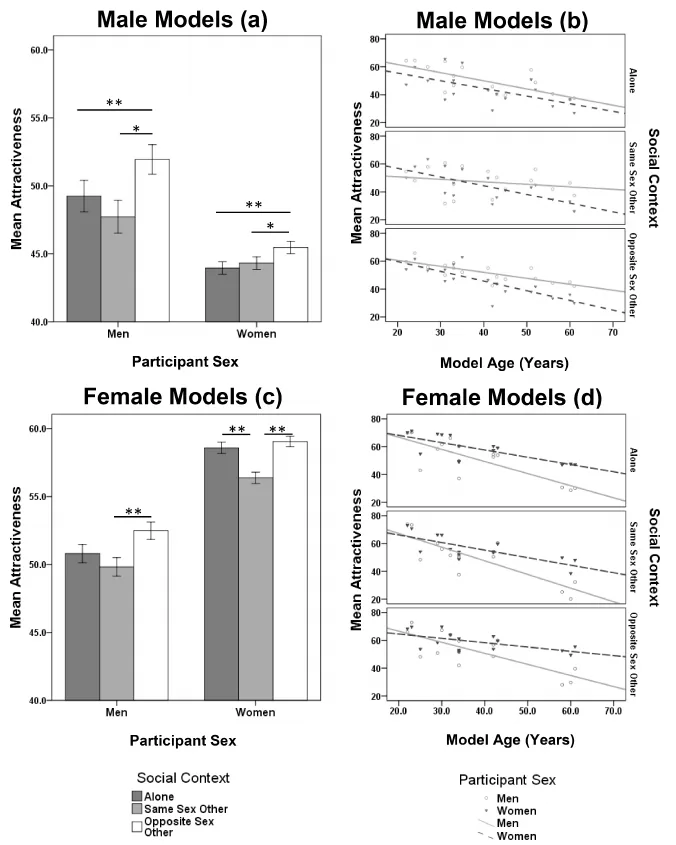
Gouda-Vossos et al. (2016): the same man, photographed with a woman, gets rated as more attractive than the same man photographed alone — by both male and female raters.
This is the cleanest empirical version of what the dating world calls pre-selection. The intuition behind it is simple. Women are not running attractiveness scans on men in a vacuum — they are trying to figure out which men other women have already validated. It is an extremely cheap, extremely efficient filter, and it is wired in deep enough that it works even on still photos of people the rater has never met. You don't have to like that this is a thing. You just have to know that it is.
The practical consequence is that your social context is part of your attractiveness whether you manage it or not. If your default state is sitting alone, eating alone, going to the gym alone, drinking alone, and then opening a dating app alone — you are broadcasting a low pre-selection signal in every direction. If your default state is being seen with people who clearly enjoy your company, including women, the signal flips.
The Doorknob Principle
How do you actually become this guy? Not by faking it. Not by hiring three female friends to stand next to you in a photo. The mechanism is simpler and harder than that. You become him by genuinely being broadly social — by talking to everyone, at low stakes, all the time.
This is what dating coaches mean when they say "talk to doorknobs." The barista. The guy in line at the bakery. The dog walker on the corner. The two girls trying to find the right table at the rooftop. The mechanic. The waitress. None of these interactions need to go anywhere. None of them need to be brilliant. The point is to keep the engine warm so that when an interaction does matter, you are already in the rhythm of being present and engaged with another human being.
"Everybody's favourite subject is themselves. Be genuinely interested in other people."
Dale Carnegie — How to Win Friends and Influence People
Carnegie's century-old advice still holds because it points at the right thing. The men who win this game are not the ones telling the most impressive stories about themselves. They are the ones asking better questions and actually listening to the answers. That is genuinely attractive in a way that pre-rehearsed lines are not, and it has the secondary benefit of being something you can practise in five-second bursts at a coffee shop.
Your Face Is Doing More Work Than You Think

Facial expressivity isn't a personality quirk — it's a measurable predictor of how much people like you.
Here is one of the more surprising findings in recent attraction research. Kavanagh, Whitehouse and Waller (2024) ran a large-scale study of facial behaviour during real social interactions — recorded video calls of 1,315 participants, plus a second study scored by 176 independent raters. They tracked how much each person's face actually moved during conversation: smiling, eyebrow flashes, the tiny micro-expressions that punctuate speech.
The result was dramatic. People who were more facially expressive were significantly more well-liked, both by their conversation partner and by third-party observers. The correlation between expressivity and being liked by raters was r = 0.48 — strong, by the standards of social science. The correlation between just smiling (the "happiness" expression) and being liked by raters was r = 0.79. That is enormous.
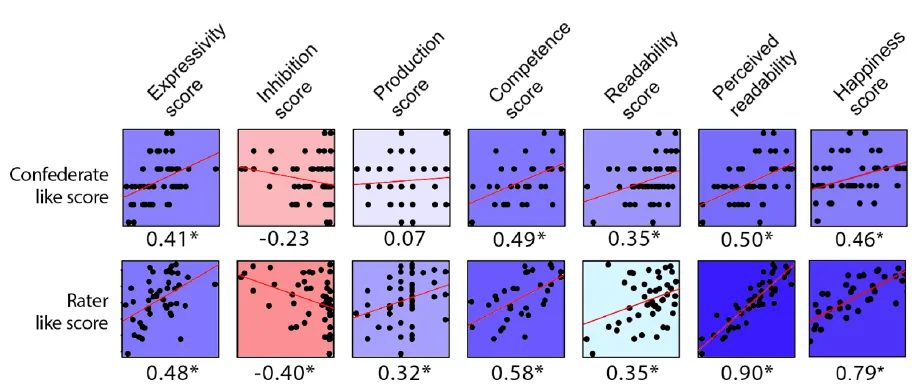
Kavanagh et al. (2024): the more your face moves during conversation — and especially the more you smile — the more both your partner and outside observers like you.
This is consistent with older work too. Roney et al. (2006) found that men's facial positivity — even when they were instructed to keep a neutral expression — independently predicted women's long-term mate attractiveness ratings. The men who came across as warmer were rated as kinder, more committed, and more attractive partners.
The "aha" here is that being expressive is not a fixed personality trait you either have or don't. It is a behaviour. And it is shaped — almost mechanically — by how often you are in genuinely engaged conversations with other people. The guy who talks to everyone develops a face that moves naturally. The guy who barely talks to anyone develops a face that doesn't. Your social diet trains your face the same way going to the gym trains your body.
How You Talk Reads as Status
Voice is the next layer most men ignore. Karthikeyan et al. (2023) tested how men's articulatory clarity — basically, how distinctly they pronounce their consonants — affected ratings of their attractiveness and social standing. The setup was clever: they used real American English speakers who naturally varied in how clearly they articulated word-final /t/ sounds (think "written" versus "wrinnen").
The findings were striking. Men who enunciated their phonemes more distinctly were rated as significantly more attractive by women for long-term relationships, and were perceived by other men as having higher prestige than physical dominance. Articulatory clarity, in other words, signals the kind of status that women select for when they are thinking about a serious partner — not a fight-night opponent.
This matters because clarity isn't really about voice training. It is, in large part, about practice. People who talk constantly — to colleagues, to strangers, to friends, to the guy at the coffee shop — develop crisper articulation as a side-effect of using their voice all day. People who barely speak develop muddy, lazy articulation that reads as low-status almost before the listener has consciously processed it.
"Low voice pitch in men systematically predicts perceptions of attractiveness, number of sexual partners, and offspring. Women have been found to prefer deep masculine voices, particularly when evaluating male voices for short-term sexual relationships."
Karthikeyan et al. (2023)
Clear articulation and a steady, slightly lower voice are both products of the same thing: regularly using your voice in real social settings. You can't develop a confident voice while sitting at home in silence. Like expressivity, it shows up in person and on the phone, but never on a profile photo. So the man who builds it has a compounding advantage every time he meets a woman in real life — or hops on a video call.
Why This Beats "Get Hotter" as a Strategy
It is fashionable, especially online, to tell men that the answer to dating is to lift, get rich, and fix their face. Some of that is true. None of it is sufficient.
Even the wealthiest, best-looking guy in the world starts to lose his shine if he is moody, isolated, has no social circle, and never seems to be enjoying himself. Women read that quickly. The reverse is also true: an average-looking guy with an active social life, friends he obviously enjoys, and the easy presence that comes from being around people often is genuinely attractive in a way that money and bone structure alone are not.
The reason is that almost every measurable predictor of male attractiveness — pre-selection, facial expressivity, articulation, calibrated body language, vocal warmth — is downstream of one underlying trait: how much you actually engage with other human beings on a regular basis. Looks and money set a floor. Social abundance moves the ceiling.
It is also the only one of these you can change quickly. Your jaw is not changing this summer. Your salary is probably not doubling this summer. But the number of low-stakes conversations you have between now and August is entirely under your control, and every single one of them is making your face move better, your voice carry more clearly, and your photos look more like a man with a life.
Translating This Online
In real life, social abundance is mostly invisible — you just are it. Online, you have to deliberately demonstrate it, because the algorithm doesn't get to watch you charm the bartender. Some practical translations.
Show that other people are having a good time around you. Group photos, candid event photos, photos at a friend's birthday or a dinner where the people next to you are laughing — these all carry pre-selection signal in the same way the Gouda-Vossos study captured. A few well-chosen group shots in your gallery do work that no solo selfie in front of a mirror can replicate.
Don't over-do it though — your dating profile is still about you. Roughly 90% of the gallery should focus clearly on you. Group photos work as supporting evidence, not as the headliner. If she has to play "Where's Waldo" to find you, the photo is not pulling its weight. The other 10% is where you let the social proof show up: one clear group shot, one candid where you are mid-laugh with someone, one event photo.
Use Instagram as the lifestyle layer. Instagram is a much better place to demonstrate a full social life than a dating profile is, because it has space for breadth. This is also one of the strongest reasons to move a match off the app to Instagram early (we covered the mechanics of getting her off the app in a previous article). It lets her see your social context at a glance, which does the work of a hundred text messages about your life.
Avoid the over-curated, over-posed look. A profile that screams "I hired a photographer" reads to most women as low-information at best and try-hard at worst. Candid, mid-motion, in-the-middle-of-a-real-moment photos beat editorial portraits almost every time, because they are doing the thing the research keeps pointing at: showing you as a man already embedded in real social situations, not auditioning for one.
The Practical Move
If you take one thing from this article, it should be that becoming socially abundant is the single highest-return thing you can do for your dating life this year. It improves your photos. It improves your voice. It improves your face. It improves the way you walk into rooms. It improves the way women perceive you within three seconds, and the way they keep perceiving you across the next three months.
The cost is small and the only barrier is the friction of doing it. Talk to the doorknobs. Talk to the barista. Ask a follow-up question. Stay 10 minutes longer at the party. Say yes when you'd usually say no. Notice that nothing bad happens. Repeat it 50 times. By the end of the summer your default has shifted, and so has your face, voice, and photo gallery — without you spending a single euro on a photo shoot.
That is the side of this game that is purely yours to build. The other side — making sure what you've built actually shows up correctly in your dating profile — is harder, because it asks you to look at your own photos through a stranger's eyes. That is the part most men get wrong, not because they lack social proof in real life, but because their gallery does not communicate the social proof they actually have.
Flairt was built around that gap. The man who is socially abundant in real life and dead on arrival on the apps is one of the most common patterns we see — and one of the most fixable.
References
- Gouda-Vossos, A., Dixson, B. J., & Brooks, R. C. (2016). Sexual Conflict and Gender Gap Effects: Associations between Social Context and Sex on Rated Attractiveness and Economic Status. PLOS ONE, 11(1), e0146269. doi.org/10.1371/journal.pone.0146269
- Kavanagh, E., Whitehouse, J., & Waller, B. M. (2024). Being facially expressive is socially advantageous. Scientific Reports, 14, 12798. doi.org/10.1038/s41598-024-62902-6
- Karthikeyan, S., Puts, D. A., Aung, T., Link, J. K., Rosenfield, K., Mackiel, A., Casey, A., Marks, K., Cristo, M., Patel, J., Santos, A., & Geher, G. (2023). Articulatory effects on perceptions of men’s status and attractiveness. Scientific Reports, 13, 2647. doi.org/10.1038/s41598-023-29173-z
- Roney, J. R., Hanson, K. N., Durante, K. M., & Maestripieri, D. (2006). Reading men’s faces: women’s mate attractiveness judgments track men’s testosterone and interest in infants. Proceedings of the Royal Society B, 273, 2169–2175. pmc.ncbi.nlm.nih.gov/articles/PMC1635527
- Leger, D. W., et al. (2025). Testing for individual differences in the effects of men’s physical attractiveness and perceived abusiveness on women’s hypothetical dating decisions.
- Carnegie, D. (1936). How to Win Friends and Influence People. Simon & Schuster.
Make sure your profile reflects the man you actually are
You built the social life. Now make your profile show it.
Flairt analyses your photos and profile against 30+ peer-reviewed studies on attraction, pre-selection, and online dating behaviour — then builds a personalised strategy so the social proof you have in real life finally lands on a 3-inch screen.
Frequently asked questions
What is social abundance in dating?
It is the habit of talking to many people regularly, not just women you find attractive. Broad social activity builds the social proof, calm and conversational range that read as attractive.
Does being more social actually make you more attractive?
Yes. Constant low-stakes interaction sharpens your body language, voice and timing, the signals people read within seconds. It also removes the neediness that comes from scarcity.
How do you practise social abundance?
Talk to people in low-pressure settings every day: baristas, gym staff, strangers in a queue. The point is reps, not outcomes, so the skill becomes automatic.