

Your MBTI Type Doesn't Predict Who You'll Fall For

She asks your type before she asks your last name. You say ISTP. She nods slowly, like that explains something. Neither of you knows what just happened, but you'll spend the next twenty minutes talking about it anyway.
That exchange happens on dates, on apps, in DMs, hundreds of thousands of times a day. Half the bios on Hinge list four letters now. Apps like Boo build entire matching systems around them, right next to your star sign. So the honest question is the same one we asked about astrology: does any of this predict whether you two actually work?
MBTI feels different from a horoscope. It has a test, a report, a citation trail. But retest a horoscope in five weeks and you get the same sign back, every time. Retest MBTI, and roughly half the room walks out with a different identity than they walked in with.
The Test That Fails Its Own Retest
A 2025 review by Rajeswari found that up to 50% of people receive a different MBTI type when retested just five weeks later. Same person, same test, same set of questions. Different letters. If a bathroom scale gave you a different weight every time you stepped on it within a month, you'd throw it out. MBTI gets printed on résumés.
Defenders point to a 2002 meta-analysis by Capraro, which pooled reliability scores across 20 studies and landed on a respectable-looking average (M = .813). Worth reading the fine print on that number: 56% of MBTI studies never bothered to report a reliability coefficient at all. The good average is built from the minority of researchers who checked their work, sitting on top of a much larger pile who didn't.
A 25-year synthesis of the current MBTI form, published in 2025 by Erford, found the same gap from another angle: the test is internally consistent, meaning people answer similar questions in similar ways on a given day. But across a quarter century of published research, actual test-retest studies, the kind that check whether your type holds up over time, were almost nonexistent. Nobody was checking.
Here's the detail that matters most for dating advice specifically: the MBTI doesn't measure neuroticism at all. Of the Big Five personality traits, the ones psychology actually treats as stable and predictive, neuroticism (how anxious, reactive, and emotionally volatile someone runs) is the one most consistently tied to relationship conflict and satisfaction. MBTI skips it entirely. You can be told you're an INFJ and learn nothing about the single trait most likely to blow up a relationship.
Same test, same person, five weeks apart. Roughly a coin flip on whether you get the same letters back.
The test isn't a scam. It's a snapshot of your mood on a Tuesday, dressed up as a diagnosis. Treating a snapshot like a fixed identity is where the trouble starts, especially when someone uses it to decide whether you two are wired to work.
Why Sixteen Boxes Is the Wrong Number
Here's the deeper problem, and it's a design flaw, not a measurement error. Most psychological traits, extroversion, anxiety, openness, whatever you want to name, follow a bell curve. Most people cluster near the middle. Few people sit at the extremes.
MBTI ignores the bell curve on purpose. It takes a continuous scale and slices it at the midpoint, and whichever side of the line you land on becomes your permanent label. Score 51% extroverted one week and 49% the next, ordinary noise, the kind every questionnaire has, and you flip from E to I. Your actual personality didn't move. The box you got filed into did.
It's less a fingerprint than a coin balanced on its edge. A small breeze either way and you get a different result, filed with total confidence as who you are.
Reviewers who've looked hard at the four dichotomies found they aren't created equal. Only introversion-extroversion shows decent validity. The other three, sensing/intuition, thinking/feeling, judging/perceiving, are weak enough that some researchers argue the entire framework should be scrapped in favor of continuous trait scores instead of hard categories. One dimension out of four is carrying the whole system's credibility.
Personality traits are distributions, not doors. Most people don't stand fully on one side of a line. They stand somewhere in the middle of a curve, and a test that forces them to pick a side is inventing a boundary that was never really there.
Summarizing the psychometric critique of MBTI's four dichotomies
Who's Selling You the Certainty
None of this stopped a whole industry from forming around it. Sixteen-type quizzes, paid compatibility reports, corporate team-building consultants, and dating apps that let you badge your four letters right next to your star sign. Nobody in that chain is lying to you exactly. They're selling certainty in a market where certainty is the product people actually want to buy.
A clean, permanent identity is comforting. "I'm an INFJ, that's just how I am" resolves an uncomfortable amount of ambiguity about who you are and who you should be with, in four letters and a Pinterest-ready aesthetic. The apps didn't invent that appetite. They just built a badge for it and put it on your profile where it can do the work of filtering matches for you, whether the filter means anything or not.
What Actually Predicts Compatibility
In 2025, Eastwick and colleagues ran the largest test of partner-matching ever conducted, more than ten thousand people, checking whether matching someone's traits to your stated "ideal partner" preferences predicts how you'll actually rate them. This is the exact question MBTI compatibility charts claim to answer. The data says something far more useful, and far less mystical, than any type chart.
Matching her specific preferences to your specific traits, the entire premise behind "ENTP and INFJ are compatible" charts, explained almost nothing. No single trait match pushed past 5% of the variance in how she rated you. Even the more rigorous version of the matching hypothesis, checking your fit across many traits at once, produced only a small-to-medium effect.
What actually moved the number was whether you came across as generally desirable, full stop, not whether you matched her specific ideal. Being read as broadly appealing, the kind of person most people would rate well, beat specific trait-matching by a wide margin. Compatibility, in the data, looked like clearing a bar most people would clear for, not two uniquely shaped puzzle pieces finding each other.
The One Type Difference That's Real
There's a twist buried in mobile dating data that's worth sitting with, because it directly involves the one MBTI dimension that actually holds up: introversion versus extroversion.
A 2019 study by Levy analyzed matching outcomes across a mobile dating app, using each user's real social behavior, not a self-typed label, as a proxy for extroversion. The finding cuts against the "opposites attract" and "matching types" stories both: introverts rarely matched effectively with other introverts. When at least one person in the pair ran more socially active, the match rate climbed, and it climbed further the higher that person's social ratio went.
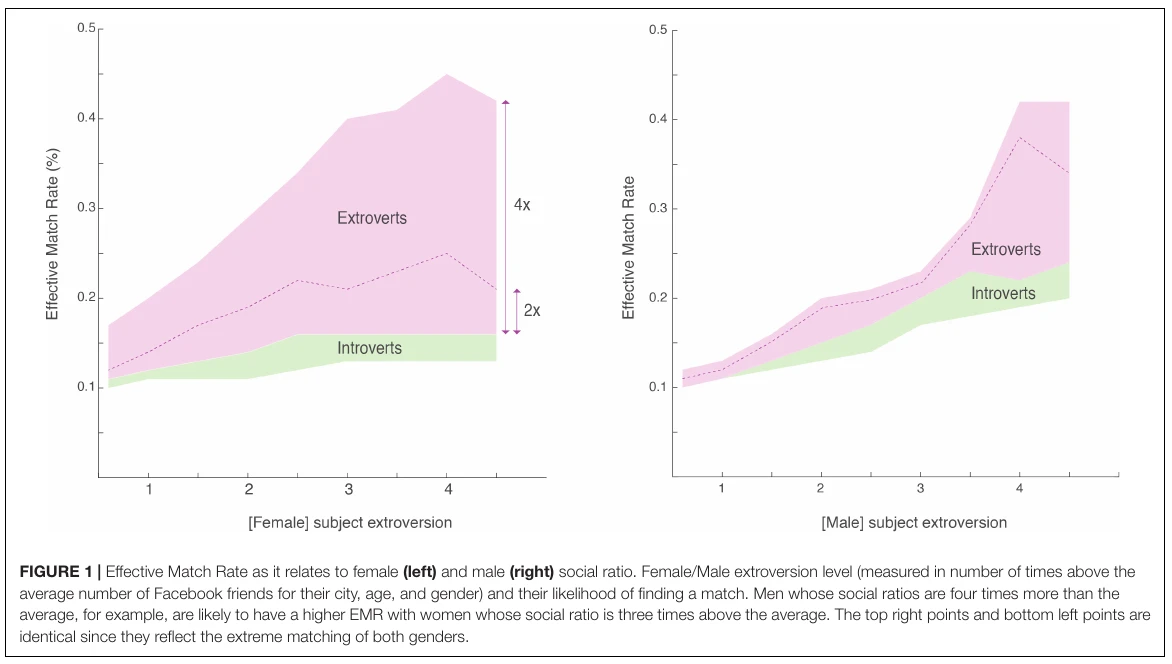
Levy (2019): match rate by social ratio. Introverts paired with introverts rarely worked. A more socially active partner raised the odds for everyone.
Men whose social ratio ran four times above average saw their effective match rate increase by 157.5%. One measurable, visible behavior, being socially engaged, did more work than any label could.
The same mobile dating data also confirmed something MBTI compatibility charts get backwards in spirit even when they gesture at it correctly: people do gravitate toward partners who resemble them, but the resemblance that matters runs through education, religion, and values, not through a four-letter personality code. Hitsch, Hortaçsu, and Ariely found the same similarity-based sorting in earlier online dating data. And Bruce Ellis's classic assortative-mating experiments, described in Matt Ridley's The Red Queen, found that people instinctively pair with partners who match their own relative desirability level, not some idealized best-case match plucked off a compatibility chart.
What To Actually Do With Your Four Letters
None of this means delete the four letters from your bio and lecture your date about psychometrics. Just like with astrology, the worst response to "what's your type?" is a citation. The letters are a fine conversation opener. They just aren't a compatibility verdict, and you shouldn't treat them, or let her treat them, as one.
Play with it. Ask what she thinks your type says about you, and whether it's ever been right. Use it as a door into what she actually values, how she wants to be treated, what she's looking for, the things the questionnaire is a clumsy, four-letter proxy for in the first place. That's the real conversation. The letters were just the invitation.

Nobody in that yard knows either man's MBTI type. Both of them are being read anyway.
What she's actually reading, across a party or in three seconds on a dating profile, is how warm, confident, and socially calibrated you come across, the traits behind "normative desirability" in the research above. That reading happens before either of you says a word about personality tests. It happens in your posture, your photos, and the impression your profile leaves in the half-second before someone decides to keep looking.
That's the good news buried in all of this. A quiz result is fixed and mostly arbitrary. How you come across is something you can actually work on, unlike your MBTI letters on any given Tuesday.
What This Means in Practice
Forget trying to signal a specific four-letter match. That read happens fast, mostly through your photos and your profile, long before anyone learns your letters, and it's worth knowing what it currently says.
Knowing exactly what you're signaling, and what needs to change to raise that baseline read, is where the actual leverage sits. Not in a quiz you might score differently five weeks from now.
References
- Rajeswari, K. (2025). Investigating the Psychometric Properties of the Myers-Briggs Type Indicator. International Journal of Social Science Research. Available at: ijssr.com
- Capraro, R. M., & Capraro, M. M. (2002). Myers-Briggs Type Indicator Score Reliability Across Studies: A Meta-Analytic Reliability Generalization Study. Educational and Psychological Measurement. Available at: semanticscholar.org
- Erford, B. T. (2025). A 25-Year Psychometric Synthesis of the MBTI Form M. Journal of Counseling & Development. Available at: onlinelibrary.wiley.com
- Eastwick, P. W., et al. (2025). A Worldwide Test of the Predictive Validity of Ideal Partner Preference-Matching. Journal of Personality and Social Psychology. Available at: pmc.ncbi.nlm.nih.gov
- Levy, K. et al. (2019). Polar Similars: Using Massive Mobile Dating Data to Predict Synchronization and Similarity in Dating Preferences. Frontiers in Psychology, 10. Available at: pmc.ncbi.nlm.nih.gov
- Hitsch, G. J., Hortaçsu, A., & Ariely, D. (2006). What Makes You Click? Mate Preferences and Matching Outcomes in Online Dating. Available at: home.uchicago.edu
- Ridley, M. (1993). The Red Queen: Sex and the Evolution of Human Nature. Harper Perennial.
Forget the four letters. Fix the four seconds.
Know exactly what your profile is actually signaling.
Flairt analyses your photos and profile against 30+ peer-reviewed studies on attraction and dating behavior, then builds a personalised strategy around what actually drives outcomes. No personality quiz required.
Frequently asked questions
Does MBTI predict dating compatibility?
No. The largest test of partner-matching ever run, covering over 10,000 people, found that matching someone's traits to your stated ideal explained almost nothing about attraction, no trait exceeded 5% of the variance. Being seen as generally desirable was a far stronger predictor than matching any specific type.
Is the MBTI test reliable?
Not very. Up to 50% of people receive a different MBTI type when retested just five weeks later. A 25-year review of the current test form found internal consistency was fine, but actual test-retest and structural validity studies were almost never conducted. Only one of the four dichotomies, introversion versus extroversion, shows decent validity.
What actually predicts relationship compatibility, if not personality type?
Being read as broadly desirable across many traits at once predicted attraction far more strongly than matching a partner's specific ideal type (Eastwick et al., 2025). Separately, people do tend to pair up with partners who resemble them in education, values, and religion, but that similarity has little to do with a four-letter personality code.
Should I put my MBTI type on my dating profile?
It's a fine conversation starter, the same way a star sign is. Just don't treat it, or let a match treat it, as a compatibility verdict. Use the question as an opening to talk about what you both actually value, not as a filter.