

Facial Symmetry and Looksmaxing: What Science Says
Looksmaxing has been the loudest word in men’s self-improvement for a few years now, and for once the trend points at something real. Being better looking genuinely makes life easier. It is one of the highest-leverage changes a man can make, ahead of getting taller and right up there with being more social or more competent. The science is not subtle about this.
Right at the center of the whole looksmaxing conversation sits one idea: facial symmetry. Get your face more symmetric, the thinking goes, and everything else follows. Some guys take that seriously enough to consider drastic measures. So before anyone reaches for a hammer or an unregulated bottle of pills, it is worth asking what the research actually says. What symmetry is, how much it really moves the needle, where the returns stop, and what you can change today without doing anything stupid.
What Facial Symmetry Actually Is
Your face is meant to be roughly the same on both sides. The small random differences between the left and right halves have a name in biology: fluctuating asymmetry. These are not the consistent quirks everyone has, like a heart that sits on the left. They are the little leftward and rightward wobbles that show up differently in every person.
Why would anyone care about millimetre wobbles? Because in animals, fluctuating asymmetry tracks something deeper. It reflects developmental stability, the body’s ability to build itself cleanly under stress. In other species, body asymmetry climbs with inbreeding, parasites, poor nutrition and pollution (Rhodes, 2005). The logic carries over to faces. A more symmetric face could, in theory, signal that its owner developed without much disruption. That is the “good genes” story you have probably heard, and it is the reason symmetry got treated as a window into mate quality in the first place.
There is a catch worth knowing early, because the gurus skip it. The honest research finds little evidence that facial symmetry actually signals health in healthy people. No study has pinned down a convincing link between facial symmetry and health in normal, non-clinical samples, and the weak associations that turned up failed to replicate (Rhodes, 2005). The biological promise is shakier than the marketing. What survives is the perception: people read symmetric faces as healthier whether or not the biology agrees, and in dating, perception is the game being played.
Does Symmetry Really Make You More Attractive?
Short answer: yes, on average, but less than you think and not on its own. The cleaner studies find that symmetry is attractive with a medium effect size for normal faces, and that it still helps even after you account for how average a face looks, so the two work as separate ingredients (Rhodes, 2005). Pull a face toward symmetry and ratings usually tick up. That part is solid and it holds for male and female faces alike.
Now the part that complicates the bro-science. When researchers pushed faces toward perfect symmetry and toward strong asymmetry, then asked people to rate them, something odd happened. In one study on Chinese male faces, the asymmetric faces were rated slightly more attractive than the symmetric ones. What really drove attractiveness was not symmetry at all but normality, how typical and natural a face looked. Symmetry helped mostly because symmetric faces tend to look more normal (Zheng, 2018). The takeaway is blunt: a face that looks natural and unremarkable beats a face that is mathematically perfect but slightly off.
It gets messier across the world. A large 2025 study found that averageness and a softer, more feminine feature set predicted attractiveness more reliably than symmetry or masculinity (Lee, 2025). In Vietnamese faces, symmetry barely correlated with attractiveness at all. Symmetry is a real ingredient, but its weight changes from population to population, while averageness keeps showing up as the steady winner.
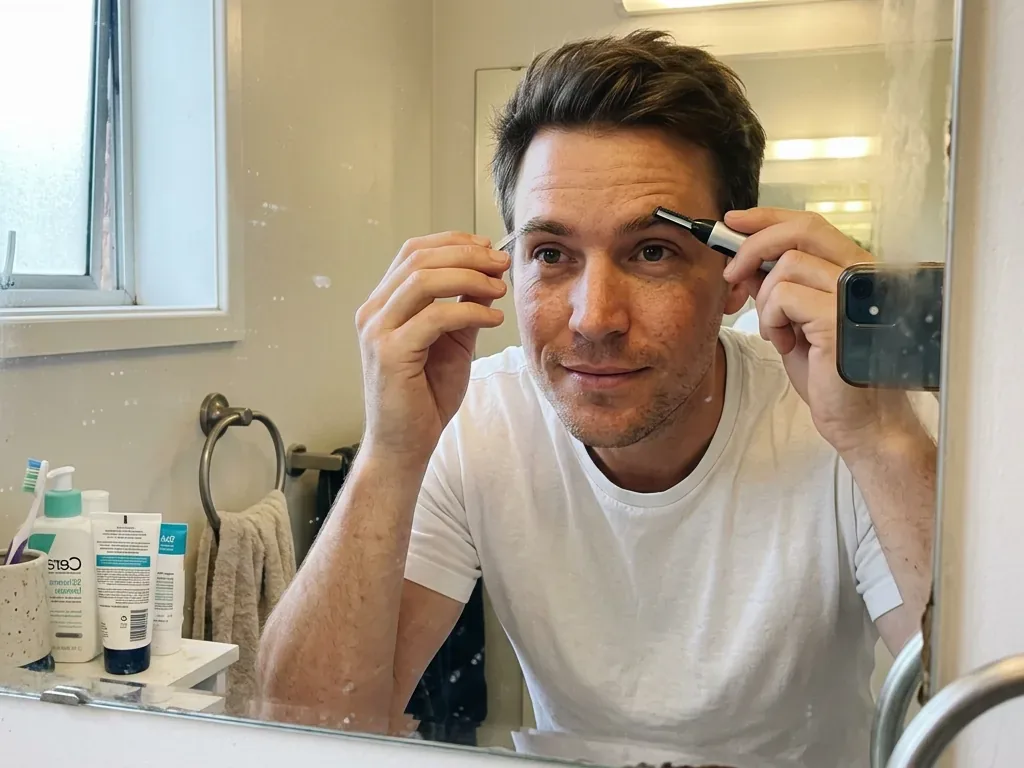
The eyebrows, skin and beard line are where most men leave easy points on the table.
So where does that leave the man reading this? In a better spot than the doom-posting suggests. Symmetry matters, but it is one lever among several, and the face that wins is the one that looks healthy, natural and well-kept, not the one that survives a geometry exam.
Where the Returns Actually Stop
Here is the most freeing finding in this whole field. People cannot even perceive symmetry past a certain point. A 2024 study scanned 50 faces in 3D, nudged some toward perfect symmetry and others toward asymmetry, then had 50 raters judge them. The eye only registers symmetry within a middle band. Once a face is already quite symmetric, making it more symmetric does nothing a viewer can detect. And once a face is strongly asymmetric, more asymmetry stops registering too (Eißing, 2024).
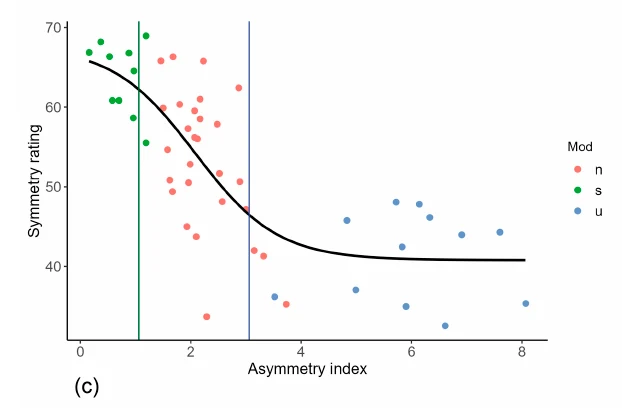
Eißing (2024), Fig. 4c: the curve is flat at both ends. Symmetry only registers in the middle band, between roughly 1.1 and 3.1 on the asymmetry index.
Look at the curve and the lesson jumps out. It is flat on both ends and steep only in the middle. That S-shape is the entire case against extreme measures. If your face already sits on the symmetric end, grinding for more perfection buys you nothing a single person will notice. The study put hard numbers on noticeable deviations too: a chin needs to drift about 6 mm before most people clock it, a nose about 4 mm, a drooping eyelid around 1.5 mm (Eißing, 2024). Small stuff slips right under the radar.
The same study landed one more clean result. The measured asymmetry of a face barely correlated with how attractive people found it, while the rated symmetry, what people thought they saw, correlated strongly (Eißing, 2024). Read that twice. The number on the 3D scan hardly predicted attraction. The impression did. How symmetric you look beats how symmetric you measure, and how you look is something a camera, a haircut and good lighting can change.
It Travels, and It Drags a Halo Behind It
One thing the field agrees on is that these preferences are not just a Western fashion. People across different cultures broadly agree on which faces are attractive, and babies stare longer at the faces adults rate as attractive before they have learned any cultural rules (Rhodes, 2005). Preferences for averageness and symmetry generalise across the race of the face. This is wired in deeper than trend.
And looking good pays beyond dating. Attractive people get judged as nicer, smarter, healthier and more competent on sight, a bias researchers call the halo effect (Eißing, 2024). Your face is doing PR for the rest of you before you open your mouth, in the job interview as much as on the date. That is exactly why the looksmaxing crowd is right that this matters, even when they are wrong about the methods.
The face that wins is not the one that passes a geometry test. It is the one that looks healthy, rested and well looked after. That face you can build.
Flairt
What to Fix, and What to Leave Alone
If perceived symmetry beats measured symmetry, and the returns flatten fast, then the smart play is obvious. Win on the things that lift how healthy and tidy your face reads, and ignore the fantasy of reshaping your skull. The high-return, low-risk moves:
- Skin first. Clear, hydrated skin reads as health more than any bone ever will. Moisturise, treat acne and blemishes, manage redness. This is the single biggest controllable lever on a face.
- Fix the eyebrows. The most overlooked feature on a man’s face. A bit of tidying, a defined arch and a cleared-up unibrow can rebalance how the whole upper face reads. Cheap, fast, underrated.
- Sharpen the beard line. A clean, even beard or stubble line frames the jaw and hides a lot of natural asymmetry. A blurry, patchy line does the opposite.
- Deal with eye bags. Sleep, hydration, less salt and less alcohol do most of the work. Tired eyes drag down the whole face and quietly kill the “healthy” signal.
- Smile properly. A genuine smile lifts attractiveness and warmth more than almost any feature you were born with. We covered why in our piece on what makes a face attractive.
- Use light and angle. Since the impression is what counts, good photography does real work. The right side, the right light and a flattering angle move perceived symmetry without touching a thing.

Grooming, skin and presentation do the heavy lifting that men keep hoping bone structure will.
For some men there is a tier above grooming, and it is fair to name it honestly. Dermatology for stubborn skin, treatment for severe under-eye bags, and in genuine cases, procedures like eyelid surgery or facial contouring exist and can help. Those are real options. They are also expensive, slow and not reversible, so they belong at the end of the list, after you have squeezed everything out of the free stuff.
Then there is the list of things to never do. Do not smash your own bones. “Bone smashing” and the harder corners of the looksmaxing world are how young men end up injured chasing millimetres that, per the research, no one would ever notice. Do not load up on poorly researched substances, hormones or supplements without a doctor. The asymmetry you are agonising over is almost certainly inside the band where humans cannot tell the difference. The downside of the drastic route is permanent. The upside is invisible.
The Real Edge Is the One You Can Take Today
Pull the threads together and the conclusion almost writes itself. Symmetry matters, but modestly. Averageness and a healthy, natural look matter more. Past a certain point nobody can perceive the difference, so chasing perfection is wasted effort. And the thing that actually predicts attraction is not the measurement of your face but the impression it gives, which is exactly the part you control.
That last point is the whole opportunity. Clear skin, tidy eyebrows, a clean beard line, rested eyes, a real smile, the right light and the right angle. None of it touches your bones, and all of it moves how symmetric, healthy and attractive your face reads on a three-inch screen. Most men never audit any of this. They assume the verdict is genetic and stop trying.
That is the gap Flairt closes. It looks at your actual photos against the same research covered here, tells you what your face is really signalling, and shows you the highest-return fixes before you ever consider anything drastic. Then its AI photo tools can present the face you already have in its best, most natural light, which the science says is what people respond to anyway. You do not need a new skull. You need the version of you that walks into the room on your best day, and a clear read on how to get there.
References
- Rhodes, G. (2005). The Evolutionary Psychology of Facial Beauty. Annual Review of Psychology, 57, 199–226. Available at: homepages.uc.edu
- Zheng, R., Ren, D., Xie, C., Pan, J., & Zhou, G. (2018). Normality mediates the effect of symmetry on facial attractiveness. Acta Psychologica. Available at: sciencedirect.com
- Lee, A. J., et al. (2025). Further evidence that averageness and femininity, rather than symmetry and masculinity, predict facial attractiveness judgments. Scientific Reports. Available at: nature.com
- Eißing, F. L., Dirksen, D., Runte, C., & Jung, S. (2024). Limits in the Perception of Facial Symmetry — A Prospective Study. Journal of Personalized Medicine, 14(11), 1109. Available at: mdpi.com
Before you chase millimetres nobody can see
Find out what your face is actually signalling.
Flairt analyses your photos against the same research in this article, then shows you the highest-return fixes — grooming, presentation and light — no surgery required. Built on 30+ peer-reviewed studies.
Frequently asked questions
Does facial symmetry actually make you more attractive?
On average, yes, but the effect is modest and it is not the whole story. Across studies, raters tend to prefer more symmetric faces, with a medium effect size for normal faces. The bigger driver is how 'normal' or average a face looks, which symmetry contributes to. Severe asymmetry hurts; small deviations barely register.
Is facial symmetry a sign of good genes or health?
That is the popular theory, but the evidence in humans is weak. Symmetry reflects developmental stability in animals, yet no study has found a convincing link between facial symmetry and health in healthy human samples (Rhodes, 2005). People still perceive symmetric faces as healthier, which is what matters for first impressions even if the biology does not fully back it up.
Can you improve your facial symmetry without surgery?
You can improve how symmetric and attractive your face reads without touching the bone. Clear skin, groomed eyebrows, a tidy beard line, reduced eye bags, a genuine smile, good lighting and the right camera angle all move perceived symmetry. Beyond a certain point the returns flatten, so basic grooming beats drastic intervention for almost everyone.