

Dating Profile Photos: A Science-Based Guide for Men
Most men have never had anyone tell them the truth about their photos. Friends say "yeah, looks good" because that is what friends say. Dating coaches give a gut reaction without any training in what a camera actually does to a face. Photographers can shoot a sharp editorial portrait, but it often looks tryhard and says nothing about your life. So the average guy uploads whatever he has, gets quiet results, and never finds out why.
The good news is that this is one of the most fixable problems in dating. A face does not change much from one week to the next, but how that face reads in a photo can change enormously with the right angle, light, expression, and setting. None of it requires good genetics. Most of it requires understanding what you are working with. Here is what the research actually supports, translated into things you can do with a friend and a decent phone.
Angles: Work With Your Bone Structure, Not Against It
When researchers measure what makes a male face read as attractive, the same features keep coming up. Faces that score higher tend to be a little narrower, a touch longer, with a projected chin and nose and a straight profile (Gkantidis, 2026). In plain terms, a more angular, defined face beats a soft, wide, flat one. A separate line of work finds that a man's facial width relative to its height tracks with how dominant he looks, and a stronger jaw reads as a healthy, masculine signal that women find attractive (McCormick, 2008; Rhodes, 2005).
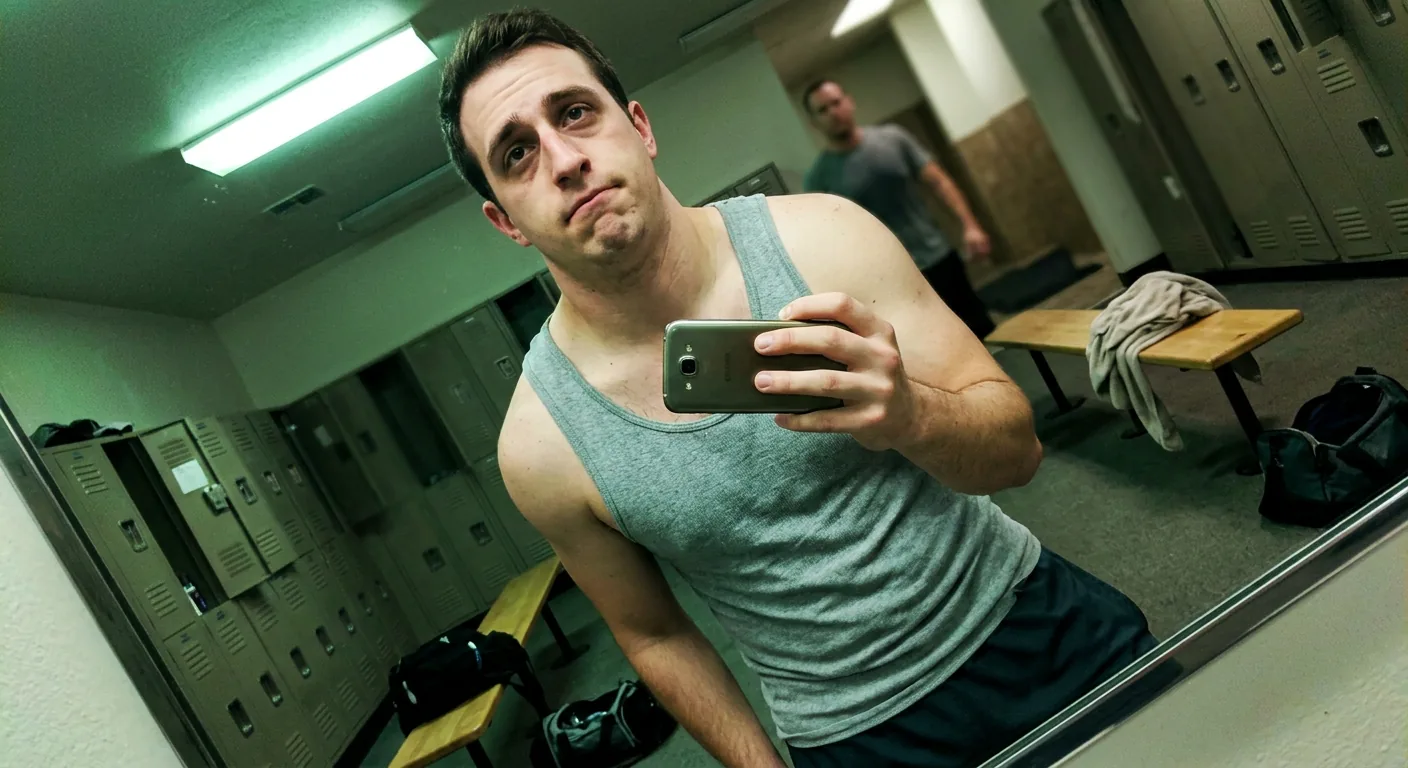
The low gym-mirror selfie does the opposite of what you want. Shooting up the nose widens the face, hides the jaw, and flattens every feature that reads as masculine.
This tells you exactly what your camera should and should not do. Shooting from below, the classic low selfie, widens your face, shortens it, and buries your jawline. It hits every wrong note at once. Shooting from slightly above eye level or dead level does the reverse: it lengthens the face a little, defines the jaw against the neck, and keeps your features in their most flattering proportion.
A few angle habits that consistently help:
- Turn about three-quarters to the camera rather than facing it flat. A slight turn brings out cheek and jaw contour instead of flattening everything into a pancake.
- Push your chin slightly forward and down (photographers call it "the turtle"). It feels unnatural and looks great, because it separates the jaw from the neck and kills any hint of a double chin.
- Keep the lens at face height or just above. A friend holding the phone beats a selfie every time, because the distance removes the lens distortion that bloats a close-up face.
One more lever sits underneath all of this. Body fat shows in the face. When researchers lowered the apparent body fat in male faces, the faces looked more masculine and more attractive, partly because a leaner face reveals more jaw and cheekbone definition (Lei, 2019; Brierley, 2016). You cannot out-angle a soft face forever, but dropping a little body fat sharpens the exact features the camera is trying to show.
Don't Chase Extreme Masculinity
There is a trap here worth flagging. Reading that "masculine equals attractive," some men assume more is always better and start hunting for the most jawline-maximising angle possible. The data does not back that up. Rhodes (2005) found the preference for masculinity in male faces is curvilinear, meaning women tend to favour moderate masculinity over extreme masculinity. A very heavy, dominant face can start to read as cold or aggressive.
So the goal is not to look like a granite action figure. It is to present the defined, healthy version of your own face and pair it with warmth. The warmth matters as much as the structure, which is the next point.
Expression: A Readable Face Wins

A real, mid-laugh expression reads as warm and trustworthy. The hard, serious stare that men think looks strong usually just looks closed off.
Plenty of men default to the same face in every photo: jaw set, no smile, a flat intense look they think signals confidence. It usually signals nothing, or worse, it reads as guarded. The research on expressiveness is clear and a little surprising.
Kavanagh (2024) found that people who are more facially expressive are better liked by strangers, more trusted, and easier to read. The mechanism is "judgeability." An expressive face lets someone feel they can read your personality, and that readability predicts liking on first impression. On a dating app, where a stranger decides in seconds, a face that gives them something to read beats a face that gives them a wall.
That is why a genuine smile, or a real mid-laugh expression, belongs on your main photo. Not a forced grin held too long, but the kind of look you get when a friend actually makes you laugh while shooting. If posing on cue feels stiff, have your friend crack a joke right before the shot. The difference between a real smile and a held one is visible, and people read it instantly.
Lighting and Skin: Soft Light Does Half the Work
Lighting is the cheapest upgrade available and the one most men ignore. Hard overhead light, the kind you get from a ceiling bulb or noon sun, drops shadows under the eyes and nose and makes skin look rough and tired. Soft, even light does the opposite. It smooths skin tone, evens out the face, and makes features read as more regular.
You do not need equipment. Two free light sources beat any studio setup for a beginner:
- Open shade on a bright day. Stand just inside the shadow line of a building or a tree on a sunny day. The light is soft, flattering, and free of harsh shadows.
- Golden hour. The hour after sunrise or before sunset gives warm, low, wrapping light that flatters almost everyone. Face toward it or keep it just off to one side.
Avoid direct midday sun (squinting, harsh shadows), overhead indoor light (raccoon eyes), and heavy filters that smear your skin into plastic. Clear, healthy-looking skin reads as health, and health reads as attractive. The fastest wins are not in editing. They are clean skin, a good night's sleep before the shoot, and standing in the right light.
Backgrounds and Social Proof: Who and What Is Around You
Your background is not filler. It is a status signal, and people read it whether or not you meant to send one. Across large studies, cues to social status raise a man's rated attractiveness, and that effect shows up for men far more than for women (Gouda-Vossos, 2016). The single most reliable quality women report wanting, across cultures and decades, is perceived social status (Manson, 2012). Your photos are where that perception starts.
Two findings are worth sitting with. First, men photographed in the company of women get rated higher, an effect researchers call mate choice copying. Being seen as someone women already enjoy being around signals that you are a safe, desirable bet. Second, even being photographed alongside other people lifts a man's perceived standing, as if the group itself implies he is socially connected.
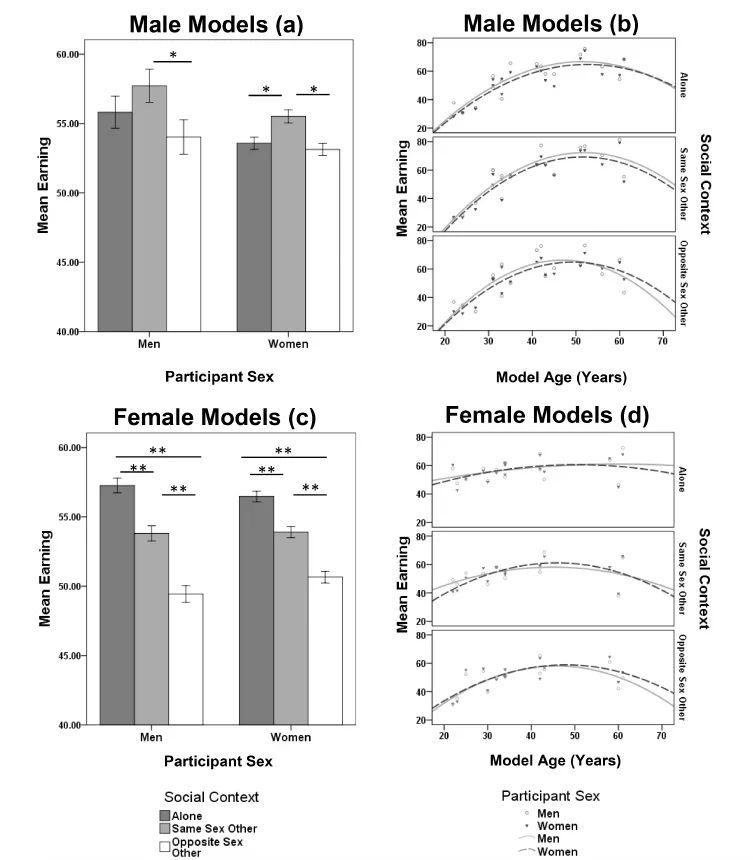
Gouda-Vossos et al. (2016), Fig 2: men were rated higher in status when photographed alongside others than when shown alone. Context lifts a man's perceived value.
This does not mean staging a fake entourage. It means choosing photos where the setting does some work for you. A shot where you are visibly the person others are engaged with, a candid from an event, a frame that shows a real interest or a place you actually go. What you want to avoid is the flip side, covered below: the group photo where you fade into the back row.
A caution on status signals. Overt wealth props, the watch laid across the frame, the rented supercar, tend to backfire in normal Western settings. They read as insecure rather than high-status. What works is behavioural status: looking like a man who is at ease, included, and worth being around. That comes through far more in a candid laugh than in a luxury prop.
Grooming: The Highest Return on the Least Effort
Grooming is where the gap between effort and payoff is widest. It costs little, changes fast, and sits entirely in your control. None of it touches your bone structure, yet it moves how attractive and how put-together you read.
The checklist is short and boring on purpose:
- A fresh haircut within the last two weeks, shaped to your face.
- A defined beard line or a clean shave. A tidy neckline and cheek line on a beard does as much for a jaw as any angle. Patchy stubble with no edges does the opposite.
- Groomed eyebrows. Eyebrows carry real weight. In a conjoint study of 922 raters, eyebrow thickness was one of the most salient features for both attractiveness and masculinity, alongside the jawline and face height (Mogilski, 2018). A few stray hairs cleaned up makes a visible difference.
- Clear skin and reduced under-eye puffiness from sleep and water.
- Clothes that fit. A fitted plain shirt beats a baggy "nice" one. Fit reads as self-respect.
None of this is glamorous, and that is the point. Most men are not losing because their face is wrong. They are losing because they uploaded a photo of an ungroomed version of themselves and called it a fair representation.
The Photos to Cut Right Now
Removing your worst photos can matter more than adding a great one, because a single weak shot drags the whole profile. Cut these:
- Every-photo sunglasses. One is fine. A whole profile of them hides your eyes, and eyes are most of what makes a face readable and trustworthy.
- The all-serious set. If not one photo shows warmth, you read as closed off. Expressiveness is an advantage; throwing it away is a choice.
- Group shots where you are not the main character. If a stranger has to guess which one is you, or worse picks the better-looking friend, the photo is working against you.
- Photos that are clearly years old. A visible mismatch with your current self reads as either insecurity or a setup for disappointment.
- Anything where you look uncomfortable. People read tension. A stiff, unhappy-looking photo transfers that feeling to whoever is swiping.
Sequencing: Build a Profile, Not a Pile
Individual photos matter, but the set tells a story. Aim for four to six photos that each do a different job:
- The lead: a clear, well-lit face shot with a genuine expression. This one carries the most weight.
- The body: one honest full or three-quarter body shot, so there are no surprises.
- The social: a candid that shows you among people, ideally one where you are clearly the centre.
- The lifestyle: one or two that hint at a real interest, a place, or an activity that says something true.
Vary the angle, the setting, and the expression across the set. A profile of six near-identical shots gives a stranger nothing to build on. A varied, readable set lets them picture a real person, and a person they can picture is a person they swipe on.
The Easiest Place to Start
The cheapest version of all this is one afternoon with a friend who has a good phone. Pick golden hour or open shade, shoot from face height, turn three-quarters, push the chin out, and have them make you laugh. Take a hundred frames and keep the four that work. That alone puts most men ahead of where they were.
The harder part is judgment. Knowing which four to keep, which angle actually suits your face, what your current photos are signalling to a stranger, and where the gap is between how you look in real life and how you look on a three-inch screen. That is the part almost no man can do for himself, because you cannot see your own face the way a stranger does.
That is what Flairt is built for. It analyses your photos against the same research covered here, tells you what each one is actually communicating, and builds a concrete plan for what to shoot, what to cut, and how to present the best honest version of yourself. Grounded in 30+ peer-reviewed studies, not gut feeling. Take everything as a rough guide, add your own character, and aim the camera at the version of you that already works.
References
- Gkantidis, N., et al. (2026). Influence of facial shape on perceived attractiveness. Available at: pmc.ncbi.nlm.nih.gov/articles/PMC13018507/
- McCormick, C. M., & Carré, J. M. (2008). In your face: facial metrics predict aggressive behaviour in the laboratory and in varsity and professional hockey players. Proceedings of the Royal Society B. Available at: pubmed.ncbi.nlm.nih.gov/18713717/
- Mogilski, J. K., & Welling, L. L. M. (2018). The Relative Contribution of Jawbone and Cheekbone Prominence, Eyebrow Thickness, Eye Size, and Face Length to Evaluations of Facial Masculinity and Attractiveness. Frontiers in Psychology. Available at: pmc.ncbi.nlm.nih.gov/articles/PMC6290027/
- Rhodes, G. (2005). The Evolutionary Psychology of Facial Beauty. Annual Review of Psychology.
- Lei, X., et al. (2019). The Influence of Body Composition Effects on Male Facial Masculinity and Attractiveness. Frontiers in Psychology.
- Brierley, M.-E., et al. (2016). The Body and the Beautiful: Health, Attractiveness and Body Composition in Men's and Women's Bodies. PLOS One.
- Gouda-Vossos, A., et al. (2016). Sexual Conflict and Gender Gap Effects: Associations between Social Context and Sex on Rated Attractiveness and Economic Status. PLOS One. Available at: pmc.ncbi.nlm.nih.gov/articles/PMC4701490/
- Kavanagh, E., et al. (2024). Being facially expressive is socially advantageous. Scientific Reports. Available at: pmc.ncbi.nlm.nih.gov/articles/PMC11176176/
- Manson, M. (2012). Models: Attract Women Through Honesty. CreateSpace Independent Publishing Platform.
Find out what your photos are actually saying
Your best photo is probably already on your phone. Let's find it.
Flairt analyses your photos against the research in this article, tells you what each one is signalling, and builds a personalised plan for what to shoot, keep, and cut. Built on 30+ peer-reviewed studies.
Frequently asked questions
What makes a good dating profile photo for men?
A clear, well-lit shot of your face taken from slightly above or at eye level, a genuine expression, tidy grooming, and a setting that says something true about your life. The research points to a few reliable levers: a defined jaw reads as more masculine and attractive (Gkantidis, 2026; Mogilski, 2018), an expressive face gets liked more (Kavanagh, 2024), and being seen around other people lifts perceived value (Gouda-Vossos, 2016).
How many photos should a guy have on his dating profile?
Aim for four to six that each do a different job. One clear face shot, one full body, one that shows a social setting, and one or two that hint at a hobby or lifestyle. Avoid filling all the slots with the same angle, the same expression, or sunglasses. Variety lets someone build a fuller picture of you, and the research shows readable, expressive faces get liked more.
Should you smile in dating profile pictures?
Yes, in at least your main photo. Facially expressive people are better liked by strangers and easier to read, which builds trust on first impression (Kavanagh, 2024). A genuine smile beats a hard, serious stare for almost every man. Keep one or two more relaxed or neutral shots for variety, but lead with warmth.