

Your Voice Is the Attraction Lever You Never Trained
You think your problem is your face. Or your height. Or the job you put in your bio. So you spend months on the one lever that barely moves and ignore the one sitting in your throat, the one you have never once thought to train. Women decide how they feel about a man in the first few seconds of hearing him talk, long before they weigh a single thing he actually said. And most men are broadcasting weakness on that channel without knowing the channel exists.
The dating-advice industry loves this blind spot. It sells you teeth, jawlines, watches, and gym splits, because those are things you can buy or grind for. Nobody sells you your own voice, so nobody talks about it. That is the gap. If you already fixed what your face is saying, this is the next lever, and it is a bigger one than anyone told you.
The Signal You Send Before You Sound Smart
Here is the uncomfortable part. Your voice is not just sound. It is a biological readout. Men with a lower vocal pitch are perceived as larger, stronger, more dominant, and better fighters, and that perception is not a random bias. Pitch is negatively correlated with testosterone and body size, it is heritable, and it may even track immune function (Karthikeyan et al., 2023). A deep voice is what researchers call an honest signal: it is expensive to fake, so listeners trust it.
The downstream effects are blunt. Across studies, low voice pitch in men predicts perceived attractiveness, number of sexual partners, and number of children (Karthikeyan et al., 2023). Women lean toward deep, masculine voices most strongly when they are sizing a man up for short-term attraction. Think of pitch as the bass line under a song. You may not consciously notice it, but take it away and the whole thing feels thin.
This is the same hormone story your face is already telling. Women's ratings of a man's attractiveness track his actual testosterone levels through his face (Roney et al., 2006), and a stronger, more masculine jaw reads as more attractive (Mogilski & Welling, 2018). Voice and face are two speakers wired to the same amplifier. A deep, resonant voice does not just add points on its own. It confirms what a masculine face already implied, and the two together are far louder than either alone.

The man who holds a table is not louder. He is clearer, slower, and unbothered by silence.
The Twist Nobody Expects: Clarity Beats Growl
If the story ended at pitch, the advice would be simple and wrong: just go lower. The most interesting finding is the one that flips it. When researchers tested how men enunciate, men who articulated their words more clearly were rated more attractive for long-term relationships, and other men judged them as having higher prestige than physical dominance (Karthikeyan et al., 2023). Clean speech signals something a growl cannot.
Why? Because articulation is a high-fidelity information carrier. Clear enunciation is linked to intelligence and executive function, and the ability to imitate sounds precisely points to a healthy cognitive and motor system (Karthikeyan et al., 2023). Even the small stuff carries weight. Crisply pronouncing the hard "t" at the end of a word instead of swallowing it reads as higher social status. The way you say "important" instead of "impor-in" tells a stranger where you came from, and their brain files you accordingly.
Sit with that inversion for a second. Depth wins the short-term glance. Clarity wins the long-term bet, the swipe that turns into a relationship, the first date that turns into a third. The mumbling deep-voiced guy is leaving the better half of the prize on the table. The fix is not a lower voice. It is a cleaner one.
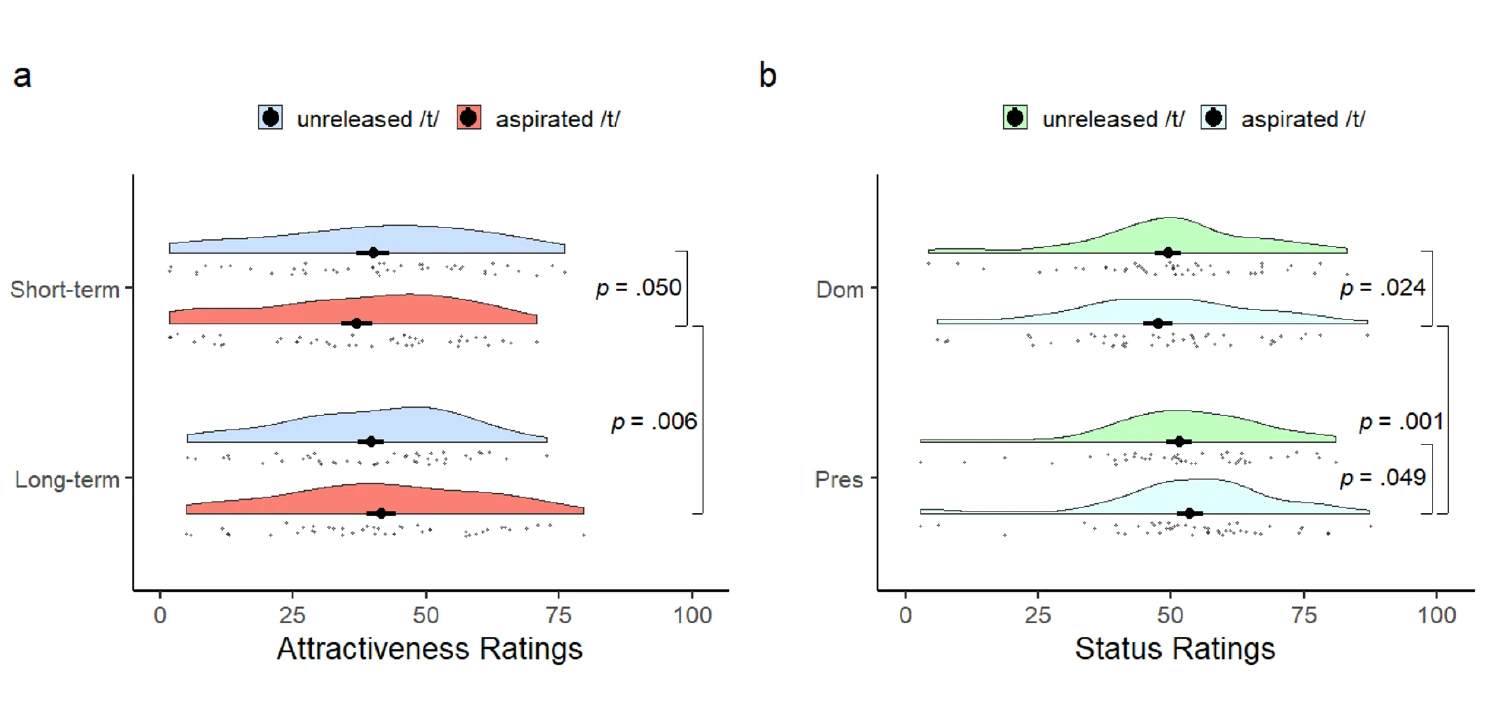
Karthikeyan et al. (2023): the men who enunciated clearly scored higher on long-term attractiveness and on prestige. Clarity, not just depth, moves the needle that matters for lasting attraction.
This is also the part that should give you hope. Depth is mostly handed to you by anatomy. Clarity is a skill. You can drill it. A man who decides to speak like he respects his own words can move himself up this exact curve, and no surgeon is required.
Slow Down. The Rush Is Reading as Fear.
Most men talk too fast. It comes from a quiet belief that if you do not get it all out quickly, people will stop listening (Manson, 2012). Read that belief back to yourself. It is the belief of a man who assumes he is not worth waiting for, and a listener hears that assumption before they hear your point.
Slowing down flips the frame. A slower pace says you expect to hold the floor, that you are comfortable taking up space and time. Then add the move almost nobody uses on purpose: the pause. Pausing deliberately creates suspense and tension, and combined with a steady look it projects an air of power and confidence (DeAngelo). The nervous man fills every silence. The confident man lets it sit, because silence does not scare him.
“Pausing on purpose creates suspense and tension. If you combine pauses with serious looks, you will create an air of power and confidence.”
David DeAngelo — Double Your Dating
Picture two men telling the identical story. One sprints through it, words tumbling, eyes darting to check if you are still with him. The other takes his time, lands each beat, and lets a two-second gap hang before the punchline. Same words. Only one of them sounds like he is used to being listened to.
Resonance: Speak From the Chest, Not the Throat
There is one more layer under pitch, and it is trainable too. Your vocal tract shapes resonance, the formants that listeners read as body size. A longer, more open tract lowers those frequencies and signals a bigger, more dominant frame; a tight, raised one does the opposite and cues smallness (Karthikeyan et al., 2023). This is why a thin, throaty voice undersells even a big man, and a full chest voice can make an average frame land larger than it is.
The coaching world figured out the practical version of this years ago. The goal is an expressive, loud voice that comes from the diaphragm and the chest rather than the throat, because a fuller, louder chest voice commands more respect and attention (Manson, 2012). You have heard it in every room you have walked into. One person speaks and the noise drops. It is rarely the loudest talker. It is the one whose voice has weight.
The Weakness Is the Whole Point
If your voice right now is thin, fast, or mumbled, stop reading that as a verdict. Read it as the opportunity it is. Your jaw is fixed. Your height is fixed. Your voice is the rare high-value trait you can actually change, and change fast. That makes it the single best return on effort available to you, and almost no other man is working on it.
The payoff does not stop at dating either. A stronger voice and better storytelling win in every room, the job interview, the pitch, the group of friends, the moment you build a presence online. In a world where your personal brand is how you move up, learning to command attention with your voice pays you back everywhere. So grab your phone, hit record, and start.

Ten minutes a day, recorded and played back, will teach you more than a year of guessing.
Here is where to start, in rough order of return:
- Record yourself and listen. The gap between how you think you sound and how you actually sound is the whole problem. Read a paragraph aloud, play it back, and you will hear the rush and the mumble instantly.
- Find your chest voice. Hum with a hand on your chest until you feel it buzz, then talk from that same place. Manson's simple drills, the hum-siren and speaking while lightly holding your nose, help you feel the difference between throat and chest.
- Cut your pace by a third. Consciously slow down and let full stops be full stops. It will feel absurdly slow to you and completely normal to everyone else.
- Enunciate the ends of words. Stop swallowing the last consonant. Clean edges on your words are read as intelligence and status, and they cost nothing but attention.
- Use one deliberate pause per point. Say the thing, then stop. Let it land before you rush to the next sentence.
One honest caveat. Not every drill fits every voice, and it is easy to overcorrect into something that sounds forced. If you are serious about it, a real vocal coach is worth the money, because a good one hears what you cannot and fixes it in a fraction of the time. Treat your voice the way you already treat the gym and your grooming. It is maintenance on the instrument you use most.
Where This Fits
There is a clean logic to the order here. First you fix what a stranger sees on a three-inch screen, because on dating apps the photo is the gate and nothing else gets read until it opens. Then, the moment a conversation moves to a call or a first date, the lever switches from how you look to how you sound. Same man, next channel.
Flairt exists for the first half of that. It audits what your photos and profile are actually saying and builds a personalised plan to close the gap, grounded in the same peer-reviewed research this article draws on. The voice is the part you take offline and build yourself, the same way you built the body and the wardrobe. The men who win at this are not lucky. They are the ones who treat every signal they send, the face, the frame, and the voice, as a problem they are allowed to solve.
References
- Karthikeyan, S., Puts, D. A., Aung, T., Link, J. K., Rosenfield, K., Mackiel, A., Casey, A., Marks, K., Cristo, M., Patel, J., Santos, A., & Geher, G. (2023). Articulatory effects on perceptions of men’s status and attractiveness. Scientific Reports, 13, 2647. Available at: doi.org/10.1038/s41598-023-29173-z
- Roney, J. R., Hanson, K. N., Durante, K. M., & Maestripieri, D. (2006). Reading men’s faces: women’s mate attractiveness judgments track men’s testosterone and interest in infants. Proceedings of the Royal Society B, 273(1598), 2169–2175. Available at: pmc.ncbi.nlm.nih.gov/articles/PMC1635527
- Mogilski, J. K., & Welling, L. L. M. (2018). The Relative Contribution of Jawbone and Cheekbone Prominence, Eyebrow Thickness, Eye Size, and Face Length to Evaluations of Facial Masculinity and Attractiveness. Frontiers in Psychology, 9, 2694. Available at: pmc.ncbi.nlm.nih.gov/articles/PMC6290027
- Manson, M. (2012). Models: Attract Women Through Honesty. CreateSpace Independent Publishing Platform.
- DeAngelo, D. Double Your Dating: What Every Man Should Know About How to Be Successful with Women. Amplitude Marketing.
Fix the first lever first
Your photos speak before you get the chance to.
Flairt analyses your photos and profile against the same research covered in this article, then builds a personalised plan to close the gap. Built on 30+ peer-reviewed studies and real platform data. Get the photo right, then go train the voice.
Frequently asked questions
Does a deeper voice make a man more attractive?
Lower vocal pitch reliably reads as more dominant and formidable, and it predicts attractiveness, number of partners and even body size, because pitch tracks testosterone honestly (Karthikeyan et al., 2023). Women lean toward deeper voices most strongly when judging short-term attraction. For long-term value, clear articulation matters just as much as depth.
Can you actually train your voice to sound more attractive?
Yes. Depth is partly fixed by anatomy, but resonance, volume, clarity and pace are trainable. Speaking from your chest, slowing down, enunciating cleanly and using deliberate pauses all shift how you are perceived (Manson, 2012; DeAngelo). Unlike your bone structure, your voice can move in weeks, which makes it one of the highest-return things you can work on.
Does how you speak matter more than what you say?
Both count, but the delivery lands first. Clear enunciation reads as intelligence and high-status upbringing, and men who articulate clearly are rated as more prestigious and more attractive for the long term (Karthikeyan et al., 2023). A strong point delivered in a rushed, mumbled voice loses to a simple one delivered with clarity and calm.