
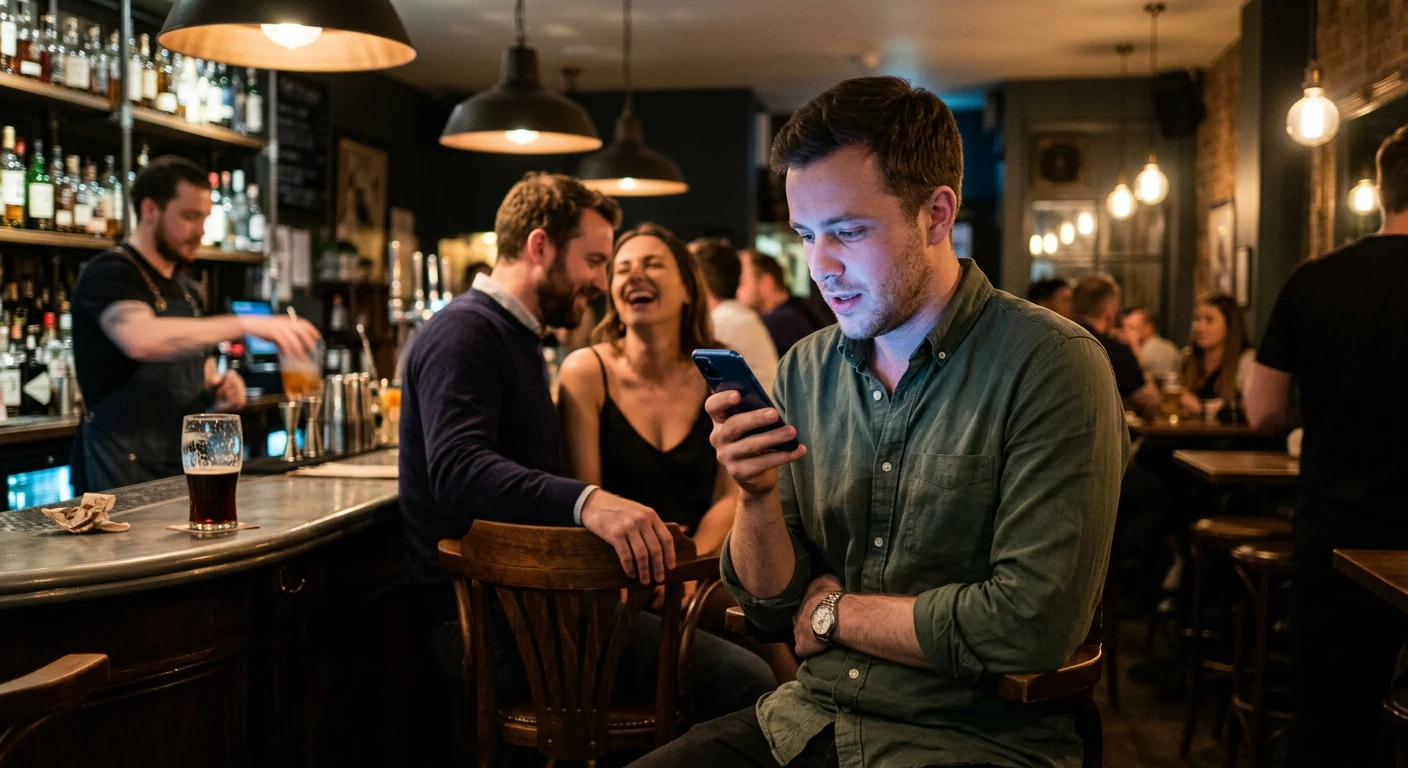
Attractiveness test: how attractive are you, really?

Every week, more than 80,000 men run some version of an attractiveness test: upload a selfie, wait a few seconds, get a number back. "How attractive am I," typed into Google at 1am, next to a photo taken under a bathroom light that does nobody any favours. The tool hands back a 6.2, and the man either feels briefly relieved or quietly wrecked for the rest of the night. Neither reaction is earned, because the test just graded the wrong thing.
Here is the honest answer. A face rater that scores one static photo measures something real: bone structure, symmetry, proportion. It does not measure how attractive you actually come across on a dating app, because that score is built from your real photos: the light, the expression, the clothes, the context. Those are two different tests, and only one of them you can pass this week.
The businesses selling you that first score are not lying about the science exactly, they are just pointing it at the wrong problem. Face-scanner apps and rate-my-face sites make their money on a click, not on your matches. They cannot tell you why a woman on a dating app swiped past you, because they never looked at the photo she actually saw. The test that actually matters is how attractive your photos make you look, not your bone structure, and you can run that one on yourself, right now, for free.
If you want an outside read that looks at your actual photos instead of your bone structure, Flairt's free Quick Insight does exactly that: up to five of your real photos, a first impression breakdown, and the specific things working against you. Everything below explains why that distinction matters, and gives you a version of the test you can run yourself in the meantime.
Is an attractiveness test accurate?
Start with the part attractiveness-test sites get right, because it is more than people assume. Attractiveness is not purely subjective. Across eleven separate meta-analyses, people agree substantially about who is and who is not attractive, and that agreement holds within a culture and across different cultures (Langlois et al., 2000). A 2026 study using a fresh rating panel found the same pattern: extensive research on facial perception shows substantial agreement in core attractiveness judgments across socioeconomic, cultural and ethnic groups, and the raters in that study agreed with each other at a level researchers consider good, an interrater reliability score of 0.79 out of 1.0 (Gkantidis et al., 2026).
So the beholder is not as unpredictable as the cliche claims. If ten strangers rate the same face, their scores cluster. An outside read on your looks is a reasonable thing to want, because other people's eyes are more reliable than your own, a point that matters a lot once you get to "am I ugly" further down. The question was never whether raters agree with each other. It is what they were actually shown when they made that judgment.
What online face rating tools measure
Most automated face raters are built the same way. A large public dataset of faces, each photographed identically (front on, neutral background, no smile), gets scored by a panel of people, and a model learns to predict that score from the geometry of the face. SCUT-FBP5500, one well known example, contains 5,500 frontal photos, each rated on a 1 to 5 scale by an average of 60 people (Liang et al., 2018). That is a legitimate way to build a model of pure facial structure, what makes a face attractive in the narrowest possible sense, stripped of everything else.
That is also exactly what it leaves out. Averageness, facial symmetry and how masculine or feminine a face reads are real components of attractiveness, and so, in the same list, are expression and grooming (Rhodes, 2005). But a dating app has never once shown a woman a neutral, front on photo of your face with a blank expression. She sees whatever you chose to post: a squint into the sun, a flash lit bar photo, a shot from three years ago when your face looked different. A face-structure score cannot account for any of that, because it was never trained on it.

The largest real-world study of this exact question backs that up. Hitsch, Hortaçsu and Ariely (2006) analysed thousands of users on a major online dating platform and had 100 independent raters score actual profile photos, not posed headshots. Looks, rated this way, explained more of the variation in who got contacted first than income or education did. The photo did the work, not the face alone. Everything visible in that photo, lighting, expression, grooming, clothing, setting, was part of what got scored, because it was part of what raters actually saw.
The attractiveness scale: what a score actually means
Say a rater or a tool hands you a 7 out of 10. What is that number, really? It is an average. In the Hitsch study, each photo was scored by 100 different raters, and the researchers standardised every rater's scores against that rater's own average and spread before combining them, specifically to cancel out the fact that some raters are simply harsher or more generous than others. Even after that correction, agreement between raters was strong, a Cronbach's alpha of 0.80. Strong agreement is not the same thing as perfect agreement.
A single number also hides how much real variance sits underneath it. Rhodes (2005) reviewed dozens of studies on the attractiveness of averaged, composite faces and found a genuine effect with real spread around it: roughly half a standard deviation, with a wide confidence range across 45 different samples. Translation: the average score is real and it means something, but a lot of individual variation sits on top of it, and your score is not a fixed property of your face. It moves with the photo you feed it. Change the photo, and you change what the test is scoring, which is the entire point of the checklist below.
The 2-minute attractiveness test for your dating photos
Here is the version of the test worth taking. It is not a validated psychological scale, and it does not claim to be. It is a self-check built from the factors above, tied to how men are actually rated in real dating photos. Pull up your current profile and answer honestly.
- Is your main photo lit by daylight or a window, not overhead bar lighting or a bathroom mirror flash?
- Are you genuinely smiling or expressive in at least one photo, not stone faced in every shot?
- Is the camera close enough, and are your eyes toward it, in at least one photo?
- Was your last haircut or grooming session within the past month?
- Do your clothes actually fit the body you have right now?
- Is there at least one full-body photo in your lineup, not only close-ups?
- Are you doing something in at least one photo, not just standing and posing?
- Is your first photo a solo shot, so a stranger does not have to guess which man is you?
- Are all of your photos from the past year?
- Would a friend say your main photo looks like you right now, not you a few years and a few habits ago?
Score one point for every "yes."
- 8 to 10: your photos are doing their job. Any remaining gains are marginal.
- 5 to 7: fixable gaps, and probably not the ones you assumed. Fix the light and the fit first.
- Under 5: your photos are actively costing you matches, independent of how you actually look.
This is a self-check, not a validated instrument, so treat the bands as a rough guide rather than a verdict. What it is built to catch is the gap between how good your photos could be and how good they currently are. Most men have never audited that gap once. For the shots that consistently do well across the research cited here, see the five photos every man needs.
Am I ugly? A straight answer
If that question brought you here, slow down before you answer it. Most men asking it are not judging their face. They are judging their worst photo, taken in their worst light, against a stranger's best one.

There is research behind why self-judgment runs this harsh. In a 2024 study, most men and women rated their own facial features as falling short of their own stated ideal (61% of men, 73% of women), a gap comparable in size to what shows up in body-image research (Perrett et al., 2024). You are probably grading your own face against a standard almost nobody meets, and doing it in a mirror, which flips your face and lights it worse than most cameras would.
So here is the honest answer, without the flattery and without the cruelty. You are very unlikely to be ugly. You are quite likely to be badly photographed. The most common pattern among men who ask this question is that they are better looking in person than in your photos, because a phone camera at arm's length in bad light does not capture what a person standing in front of you sees. It is a specific, correctable failure, and the data above keeps pointing at the same four causes: light, angle, expression, context.
What this article will not tell you to do is chase a jawline with a filing tool or starve yourself into a different face shape. None of the research cited here supports that, and the men who go looking for it usually end up worse off than when they started. The lever that actually moves is presentation, not surgery.
How to become more attractive in photos
The good news buried in all of this: most of what gets rated is not fixed. Grooming, fit, expression and how you present yourself change how attractive you are read as, and the effect is not small. Clothing that signals status specifically raised men's attractiveness ratings in controlled studies (Gouda-Vossos et al., 2016). A face that moves and expresses reads as more likeable in conversation, which is most of what earns you a reply in the first place (Kavanagh et al., 2024). Even body composition plays a role: facial cues linked to muscle mass measurably raise how masculine a face is perceived to be (Lei, Holzleitner & Perrett, 2019).
None of this is about becoming a different person. It is about presenting the one you already are competently, which most men have simply never been taught to do. For the full breakdown of what is fixed and what is not, and exactly how each piece moves the numbers, see how to be more attractive as a man.
The photo is the thing you can actually fix
Put the two tests side by side. A face rater gives you a number about bone structure you cannot change, then leaves you alone with it. Real anxiety, in exchange for a piece of information that predicts almost nothing about your actual dating app results. That is a bad trade.
The test that matters, built on the same kind of research this article draws on, looks at your real photos and asks what a stranger scrolling past would actually see. That is what Flairt's free Quick Insight does: upload up to five of your current photos and get a first impression breakdown and the specific attraction blockers working against you, not a number you cannot act on.
References
- Langlois, J. H., Kalakanis, L., Rubenstein, A. J., Larson, A., Hallam, M., & Smoot, M. (2000). Maxims or myths of beauty? A meta-analytic and theoretical review. Psychological Bulletin, 126(3), 390 to 423. psycnet.apa.org/record/2000-15386-005
- Gkantidis, N., et al. (2026). Influence of facial shape on perceived attractiveness. pmc.ncbi.nlm.nih.gov/articles/PMC13018507/
- Liang, L., Lin, L., Jin, L., Xie, D., & Li, M. (2018). SCUT-FBP5500: A diverse benchmark dataset for multi-paradigm facial beauty prediction. ICPR 2018. arxiv.org/abs/1801.06345
- Rhodes, G. (2005). The evolutionary psychology of facial beauty. homepages.uc.edu/~martinj
- Hitsch, G. J., Hortaçsu, A., & Ariely, D. (2006). What makes you click? Mate preferences and matching outcomes in online dating. University of Chicago / MIT. Working paper. home.uchicago.edu/~hortacsu/onlinedating.pdf
- Perrett, D. I., et al. (2024). Misperception of the facial appearance that the opposite-sex desires. PLOS ONE. journals.plos.org/plosone
- Gouda-Vossos, A., et al. (2016). Sexual conflict and gender gap effects: associations between social context and sex on rated attractiveness and economic status. pmc.ncbi.nlm.nih.gov/articles/PMC4701490/
- Kavanagh, E., Whitehouse, J., & Waller, B. M. (2024). Being facially expressive is socially advantageous. Scientific Reports, 14, 12798. pmc.ncbi.nlm.nih.gov/articles/PMC11176176/
- Lei, X., Holzleitner, I. J., & Perrett, D. I. (2019). The influence of body composition effects on male facial masculinity and attractiveness. Frontiers in Psychology, 9, 2658. pmc.ncbi.nlm.nih.gov/articles/PMC6328455/
Run the test that actually predicts your matches
Your photos are being scored right now. See what they actually say.
Flairt analyses your real photos against the same research covered in this article, then builds a personalised strategy to close the gap. Built on 30+ peer-reviewed studies and real platform data.
Frequently asked questions
How accurate are online attractiveness tests?
People genuinely agree on what looks attractive, so the underlying science is sound. The problem is what most tools measure: a single neutral photo of your face, not the real, in-context photos a dating app actually shows, so the result rarely predicts how you are rated there.
How can I tell if I'm attractive?
Stop guessing from a mirror and look at how people respond to your real photos, not your face in isolation. Run a self-test on your current dating photos (light, expression, grooming, fit) instead, since that is what other people are actually judging.
What does a 7 out of 10 attractiveness score mean?
It is an average across many raters, standardised so no single harsh or generous rater skews it. Raters agree more than people expect, but agreement is not unanimity, and the same face can score differently depending on which photo was rated.
Am I ugly, or are my photos bad?
For most men who ask this, it is the photos. Lighting, expression, grooming, fit and context all change how attractive a face is rated, often more than the face itself does. Most men judging themselves as ugly are comparing their worst photo to someone else's best.
Can you become more attractive?
Yes, in the ways that get measured. Grooming, fitted clothing, an expressive face and some added muscle all raise how attractive a man is rated in controlled studies. Bone structure stays fixed. Nearly everything else that gets judged does not.
Is there a free attractiveness test for dating photos?
Yes. Flairt's free Quick Insight looks at up to five of your actual photos and gives you a first impression breakdown along with the key attraction blockers in your current lineup, at no cost.